
A Straight-Talking Look at What’s Really Happening (From LiquidMash)
If you’re running a hotel, guesthouse, or lodge in Cape Town or the Western Cape, you’ve likely felt this:
You’re getting website traffic… but your direct bookings aren’t where they should be.
Meanwhile, your rooms are still being filled — just through Booking.com, Expedia, or Agoda.
At LiquidMash, this is one of the most common problems we see when hotel owners come to us.
And it usually comes down to one thing:
Your SEO isn’t working hard enough for your business.
In this blog, we’ll break down in plain English, why that’s happening, what it’s costing you, and how a focused hotel SEO strategy can help you take back control of your bookings.
The Cost You Don’t See: Lost Direct Bookings
Let’s walk through a real-world scenario.
A traveller searches:
- “hotels in Cape Town”
- “boutique hotel near V&A Waterfront”
- “best places to stay in Western Cape”
They click a result.
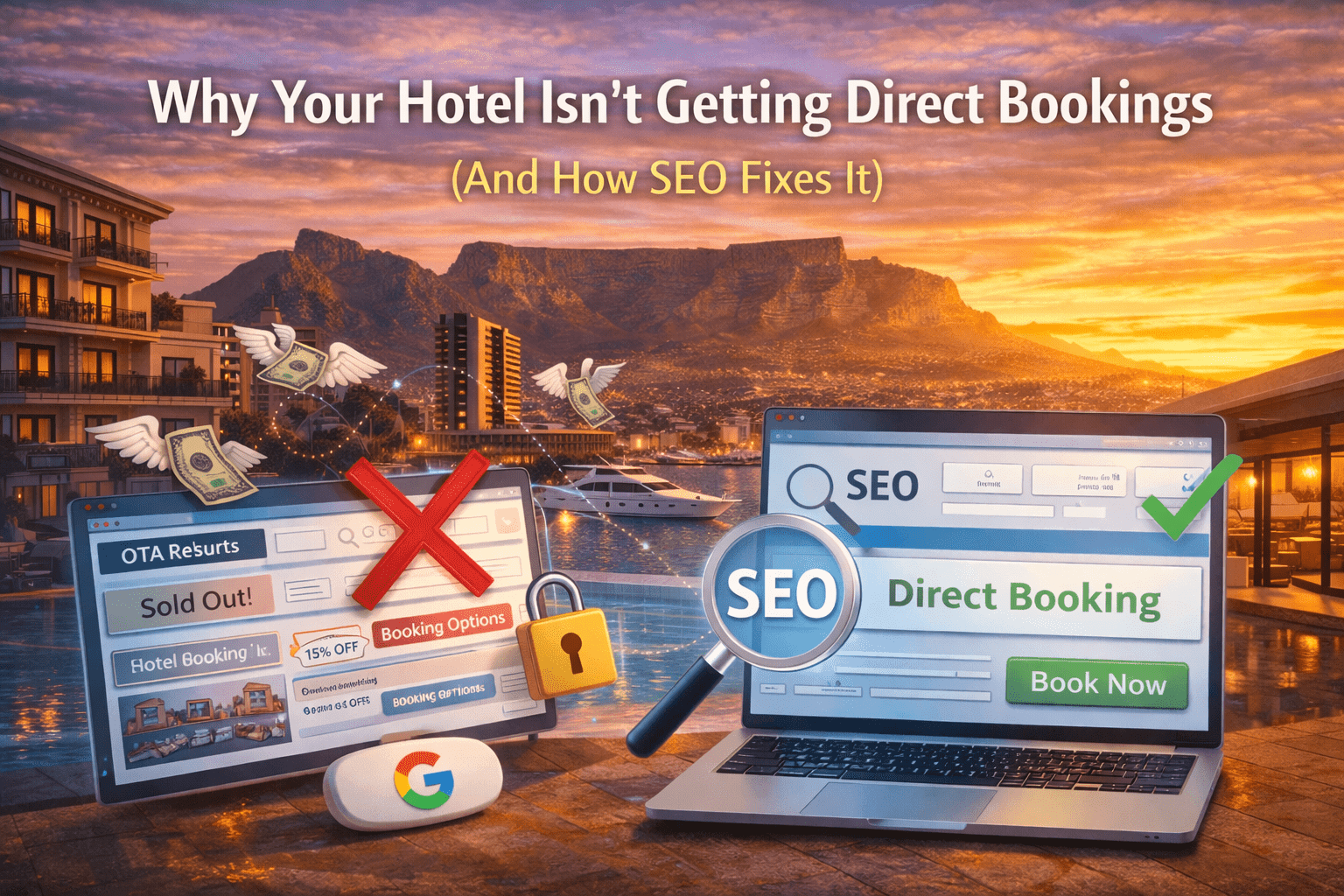
But instead of landing on your website, they land on an OTA.
From there, it’s game over:
- They compare prices
- They browse alternatives
- They book through the platform
Even if they choose your hotel, you’ve still:
- Paid commission (often 15–30%)
- Lost control of the guest relationship
- Missed future direct bookings
At LiquidMash, we don’t see this as a marketing issue.
We see it as a revenue leakage problem caused by poor visibility.
Why This Happens (Especially in Cape Town & Western Cape)
Cape Town isn’t just competitive, it’s saturated.
You’re up against:
- International hotel brands
- Well-established guesthouses
- OTAs with massive SEO authority
Without a deliberate SEO strategy, your website simply doesn’t stand a chance.
1. You’re Not Showing Up When It Matters
If your hotel isn’t on page one of Google, you’re effectively invisible.
And if you’re not ranking for searches like:
- “luxury hotel Cape Town waterfront”
- “guest house Stellenbosch wine farm”
- “accommodation near Table Mountain”
You’re missing people who are ready to book.
2. OTAs Are Outranking Your Own Brand
This is something we check immediately when working with a new hotel.
Search your hotel name.
If Booking.com or Expedia appears above your website, you’re losing high-intent brand traffic — the easiest bookings to win.
3. Your Website Looks Good — But Doesn’t Perform
Design isn’t the same as performance.
Many hotel websites we audit have:
- Slow load speeds
- Weak mobile experience
- Poor content structure
- No clear booking journey
The result?
Visitors arrive… and leave.
4. You’re Targeting the Wrong Searches
Trying to rank for “hotel Cape Town” alone isn’t a strategy, it’s a long shot.
What actually works is targeting specific, high-intent searches like:
- “hotel near Cape Town airport with shuttle”
- “romantic getaway Western Cape sea view”
- “family-friendly accommodation Cape Town”
These are the searches that convert into bookings.
How We Approach Hotel SEO at LiquidMash
We don’t treat SEO as a checkbox exercise.
We treat it as a direct booking growth system.
Here’s what that means in practice.
1. We Target Guests Who Are Ready to Book
Not just traffic. Intent.
We focus on keywords that indicate someone is actively planning or booking a stay.
That means better traffic and higher conversion rates.
2. We Help You Compete With OTAs (Not Rely on Them)
OTAs aren’t the enemy, but over-reliance on them is.
Our goal is to:
- Increase your direct visibility
- Strengthen your brand presence in search
- Give guests a reason to book directly
3. We Turn Your Website Into a Booking Asset
Your website should do more than exist, it should convert.
We optimise:
- Room and offer pages
- Location-based landing pages
- Internal linking and structure
- Calls-to-action and booking flow
Everything is designed to move a visitor closer to booking.
What’s Working Right Now (From Our Experience)
Based on what we’re seeing across hotel SEO campaigns in South Africa, a few things consistently move the needle.
Local SEO Is Non-Negotiable
Searches like:
- “hotel near me”
- “accommodation Cape Town CBD”
Drive a huge amount of bookings.
If your Google Business Profile and local signals aren’t optimised, you’re missing out.
Content That Matches Real Travel Behaviour
People don’t just search for hotels, they search for answers.
Content like:
- “where to stay in Cape Town for couples”
- “best areas to stay in Western Cape”
Allows your hotel to show up earlier in the decision process.
Authority Still Wins
Google rewards trust.
We build this through:
- High-quality backlinks
- Relevant travel mentions
- Consistent, optimised content
SEO vs Paid Ads: A Practical View
We’re not anti-ads, but we are realistic about them.
Paid Ads
- Quick visibility
- Stops when spend stops
- Can become expensive
SEO
- Builds over time
- Brings consistent traffic
- Improves ROI month after month
For hotels serious about long-term growth, SEO becomes the foundation.
What Results Should You Expect?
SEO is a medium- to long-term investment, but it compounds.
Months 1–3
- Technical fixes
- Keyword alignment
Months 3–6
- Ranking improvements
- Traffic growth
Months 6–12
- Noticeable increase in direct bookings
- Reduced OTA dependence
Is SEO Worth It for Your Hotel?
If you’re relying heavily on OTAs or struggling to generate direct bookings, then yes, absolutely!
It’s particularly impactful for:
- Boutique hotels in Cape Town
- Guesthouses across the Western Cape
- Luxury lodges
- New or repositioning properties
Frequently Asked Questions (FAQ)
What is SEO for hotels?
SEO for hotels is the process of improving your website so it ranks higher on Google when people search for accommodation, helping you generate more direct bookings.
How does SEO increase direct bookings?
By ensuring your website appears before OTAs in search results, SEO allows guests to find and book directly with you.
How long does hotel SEO take?
Most hotels see movement within 3–6 months, with stronger results developing over 6–12 months.
What keywords should my hotel target?
A mix of:
- Location-based terms (e.g. “hotels in Cape Town”)
- Experience-based terms (e.g. “romantic hotel Western Cape”)
- Long-tail queries (e.g. “hotel near Table Mountain with views”)
Is SEO better than Booking.com?
It’s not about replacing Booking.com, it’s about reducing reliance on it and improving your margins through direct bookings.
Do smaller hotels benefit from SEO?
Yes, often the most. SEO allows smaller properties to compete with larger brands and OTAs.
Final Thoughts from LiquidMash
The way travellers book accommodation has changed.
Everything starts with a search.
If your hotel isn’t visible at that moment, you’re not part of the decision.
But when your SEO is working properly, you can:
- Capture high-intent demand
- Increase direct bookings
- Build a stronger, more profitable business
Thinking About Improving Your Hotel SEO?
If you’re looking to reduce OTA reliance and grow direct bookings, SEO is one of the most effective levers available.
At LiquidMash, we work specifically with hotels in Cape Town and the Western Cape to do exactly that. With a focus on results, not just rankings.
Your future guests are already searching.
The question is: are they finding you, or someone else?
