
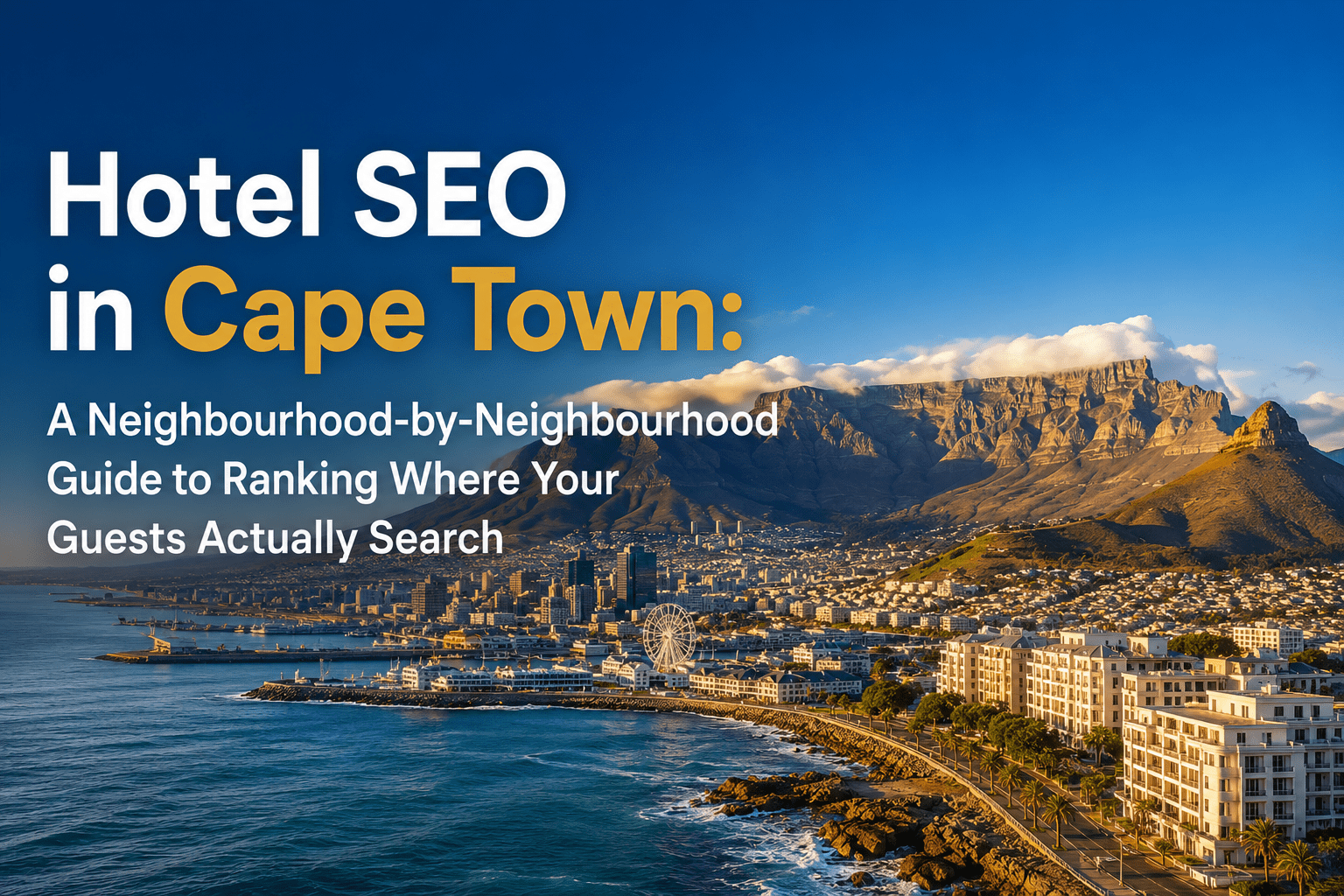
Cape Town is one of the most searched travel destinations in Africa. It’s also one of the most competitive hotel markets in the southern hemisphere, a city where Booking.com, Expedia, and Airbnb have invested millions into ranking for every meaningful search term, and where a small boutique hotel in Sea Point is simultaneously competing with a 300-room Radisson and an entire page of OTA listings.
Yet independent hotels across Cape Town are quietly winning direct bookings that their competitors aren’t. Not through bigger budgets. Through smarter geography.
The insight is this: Cape Town travellers don’t just search for ‘hotels in Cape Town’. They search for hotels in specific neighbourhoods, near specific landmarks, for specific kinds of experiences. And in those specific searches, a well-optimised independent hotel can and does outrank platforms that spread themselves too thin to optimise deeply for any single area.
Who this is for Hotel owners, revenue managers, and marketing leads at properties in Cape Town, Camps Bay, the V&A Waterfront, Sea Point, Green Point, Constantia, Stellenbosch, and the broader Western Cape.
Why Cape Town hotel SEO is uniquely complex
Most cities have one dominant traveller profile. Cape Town has at least five, each with different search patterns, different booking windows, and different neighbourhoods on their shortlist.
You have international leisure travellers planning mountain-and-beach itineraries six months out. You have domestic South African weekenders booking on a Wednesday for the coming weekend. You have honeymoon couples researching Cape Winelands lodges. You have business travellers attending the Cape Town International Convention Centre. You have whale watchers heading to Hermanus for a long weekend.
Each of these travellers uses different search terms, lands in different neighbourhoods, and converts at different points in their planning journey. A Cape Town hotel SEO strategy that ignores this segmentation, that targets only ‘hotels Cape Town’ and leaves most of its opportunity on the table.
The practical problem OTAs are optimised for broad, high-volume searches. Independent hotels can’t compete there. But they can dominate the specific, intent-rich searches that OTAs can’t replicate, because those searches require local knowledge, neighbourhood expertise, and content that a platform listing 50,000 properties simply cannot produce at depth.
The Cape Town neighbourhood search map: what travellers actually type
Before building any SEO strategy for a Cape Town hotel, it helps to understand which neighbourhood your property sits in — and how people search for it. Here’s how the major areas break down:
V&A Waterfront & City Bowl — International arrivals, conference delegates, luxury seekers
The highest-competition area in Cape Town for hotel searches. The V&A Waterfront draws international leisure travellers looking for landmark proximity, harbour views, and easy access to Table Mountain and Robben Island. Search terms skew premium: ‘luxury hotel V&A Waterfront’, ‘hotel near Two Oceans Aquarium’, ‘Cape Town city centre five star’. Conference traffic adds a commercial layer: ‘hotel near CTICC’, ‘business hotel Cape Town CBD’.
SEO opportunity: The competition here is intense, but properties can win on specificity, ‘sea-facing suite V&A Waterfront’ or ‘hotel walkable to Cape Town ferry terminal’ are far less contested than the broad terms.
Camps Bay — Leisure premium, honeymoons, Instagram-driven bookings
Camps Bay has its own distinct search universe. Travellers searching here know they want the beach promenade, the mountain backdrop, and the Clifton-adjacent lifestyle. Searches include ’boutique hotel Camps Bay’, ‘Camps Bay accommodation with pool’, ‘romantic hotel Atlantic Seaboard Cape Town’.
Notably, a significant portion of Camps Bay searches now come from travellers who have already seen the area on social media, they’re searching with aesthetic intent rather than purely functional intent. Content that mirrors this (atmospheric, experience-led) converts better here than anywhere else in Cape Town.
Sea Point & Green Point — Value-conscious internationals, repeat visitors, sports travellers
Sea Point and Green Point attract travellers who want Cape Town proximity without V&A pricing. The promenade, Mouille Point lighthouse, and Green Point Stadium give this strip its own identity. Search terms: ‘guesthouse Sea Point Cape Town’, ‘hotel near Green Point Stadium’, ‘accommodation Sea Point promenade’.
Green Point picks up event-specific traffic when major concerts, matches, or festivals are announced at DHL Newlands or the Cape Town Stadium, search volume for this neighbourhood spikes sharply. Hotels here that publish event-specific content in advance capture this traffic before OTAs do.
Constantia, Southern Suburbs & Winelands — Domestic luxury, wedding guests, wine tourism
Constantia and the Southern Suburbs serve a fundamentally different traveller, often domestic, often returning, often booking for special occasions. The proximity to wine estates and Kirstenbosch defines the search landscape: ’boutique hotel Constantia vineyards’, ‘wedding venue accommodation Southern Suburbs’, ‘guesthouse near Kirstenbosch Cape Town’.
Extending out to Stellenbosch and Franschhoek, the Winelands search market is distinct enough to warrant its own content strategy and distinct enough that a Cape Town-focused page won’t capture it. Separate neighbourhood landing pages are essential for properties operating in this corridor.
Hermanus & Garden Route — Seasonal peaks, whale watching, eco-travellers
Hermanus operates on its own seasonal logic entirely, whale season (June to November) creates a demand spike unlike anything seen in the city. Searches like ‘hotel Hermanus whale watching’, ‘beachfront accommodation Hermanus September’, and ‘Overberg guesthouse’ spike dramatically and predictably.
Hotels here that publish seasonal content before June, anticipating whale season searches months before the season peaks, capture early bookers who plan ahead. This is an SEO play that requires lead time, and most properties miss it.
Seasonality: the hidden driver of Cape Town hotel SEO
Cape Town has a pronounced seasonal demand curve that most hotel SEO strategies don’t account for. School holiday peaks (December–January, Easter, July), the Cape summer festival season, Stellenbosch’s harvest in February and March, the Cape Town International Jazz Festival in April, Design Indaba in February, each of these creates predictable search spikes that content can be built to capture months in advance.
The missed opportunity: Most Cape Town hotels publish content reactively, writing about events after they’ve started, when the search traffic has already peaked. An SEO strategy built around Cape Town’s event and seasonal calendar, with content published 8–12 weeks before each peak, captures the early planners who make up the highest-converting segment of leisure bookings.
- Publish ‘best hotels near Cape Town Jazz Festival’ content in February for an April festival
- Create ‘whale season accommodation Hermanus’ content in April for a June–November whale season
- Publish summer holiday accommodation guides in September for a December–January season
- Build Stellenbosch harvest content in November for a February–March harvest season
Timing note Google typically takes 6–12 weeks to index and rank new content. Building seasonal content into a forward-looking editorial calendar, rather than reacting when demand already exists, is one of the highest-ROI tactics available to Cape Town hotels.
What effective hotel SEO looks like for a Cape Town property
Dedicated neighbourhood landing pages
A single ‘Cape Town hotel’ page cannot rank well for Camps Bay, V&A Waterfront, Sea Point, and Constantia simultaneously, the search intent for each is distinct enough that Google treats them as separate queries. The properties that consistently appear in neighbourhood-specific searches have dedicated pages for each area they serve, each optimised for its own keyword set and traveller profile.
Google Business Profile by location
For multi-location groups or hotels with distinctive venue spaces (conference centre, spa, restaurant), individual GBP listings for each distinct offering can dramatically improve local pack visibility. At minimum, the main hotel GBP should have: complete and accurate business information, 50+ photos updated regularly (Google rewards freshness), review responses within 48 hours, and GBP posts tied to upcoming Cape Town events and seasonal promotions.
Schema markup for rich results
Hotel schema markup tells Google precisely what your property offers: star rating, price range, amenities, room types, check-in/check-out times. In a search results page dominated by OTA listings, rich results displaying your direct pricing and review score make your listing visually distinct. Cape Town’s international traveller base means this also needs hreflang consideration for UK, German, Dutch, and Australian audiences who make up a significant share of inbound leisure traffic.
Content that captures the planning journey
Cape Town’s international travellers typically spend 2–4 weeks in a research phase before booking. During that phase, they’re searching for things beyond ‘hotels’ ; area guides, things to do, transport options, weather, packing tips. A Cape Town hotel that produces content serving the planning journey (not just the booking moment) captures these early-funnel visitors, builds trust, and converts a meaningfully higher proportion of them into direct bookings than a website offering only a room listing.
- ‘Best time to visit Camps Bay’ — targets the planning phase, 3–6 months out
- ‘Where to stay in Cape Town for Table Mountain access’ — captures comparison-phase searches
- ‘Cape Town airport to V&A Waterfront: transport options’ — serves practical queries, builds trust
- ‘Green Point local guide: restaurants and walks within 10 minutes’ — establishes neighbourhood authority
The Cape Town SEO advantage most hotels aren’t using
Cape Town receives substantial international press coverage, travel publications, food guides, lifestyle magazines, sustainability rankings. This creates a natural backlink opportunity that cities like Johannesburg simply don’t have at the same volume.
Hotels that actively pitch for coverage in publications like Condé Nast Traveller, Tatler, Getaway, and specialist international travel media are building domain authority that compounds. Each mention adds weight to their rankings, not just their reputation. The same applies to Cape Town Tourism listings, Cape Town Routes Unlimited, and the various Western Cape tourism board platforms, all of which carry significant local authority.
One tactic worth highlighting: Cape Town’s film and TV production activity, the city is frequently used as a filming location. This creates niche but high-intent search traffic from production companies seeking accommodation for cast and crew. Hotels that create content targeting this specific use case often find it converts at an unusually high rate, with long stay lengths and early booking windows.
Frequently asked questions
Is Cape Town hotel SEO harder than other South African cities?
More competitive, yes, but not necessarily harder to get right. The competition is higher because the market is larger and more international. But the same dynamics that make it competitive also create more opportunities: higher search volumes, more content angles, more seasonal events to build around, and a more active media and travel press ecosystem to build authority through.
Do we need separate pages for Cape Town and the Winelands?
If your property is in the Winelands or serves both markets, yes. Stellenbosch and Franschhoek searches are geographically and intentionally distinct from Cape Town city searches, they attract different traveller profiles, peak at different times of year, and require different keyword strategies. Trying to capture both from a single page typically means ranking strongly for neither.
How quickly will we see results in Cape Town’s competitive market?
Google Business Profile improvements in lower-competition neighbourhood searches can show movement in 4–8 weeks. New neighbourhood landing pages typically see initial ranking movement within 8–12 weeks. Competitive terms like ‘hotel V&A Waterfront’ require 4–9 months to build meaningful ranking through content and authority. The compounding nature of SEO means that a strategy started today is worth substantially more in month 12 than in month 3.
Get a free Cape Town hotel SEO audit
LiquidMash audits your Cape Town hotel’s local rankings, Google Business Profile, neighbourhood keyword gaps, and seasonal content opportunities — completely free, delivered within 48 hours, worth R5,000. No pitch until you’ve seen the data.
→ Book your free strategy call: liquidmash.io/hotel-seo-agency
