
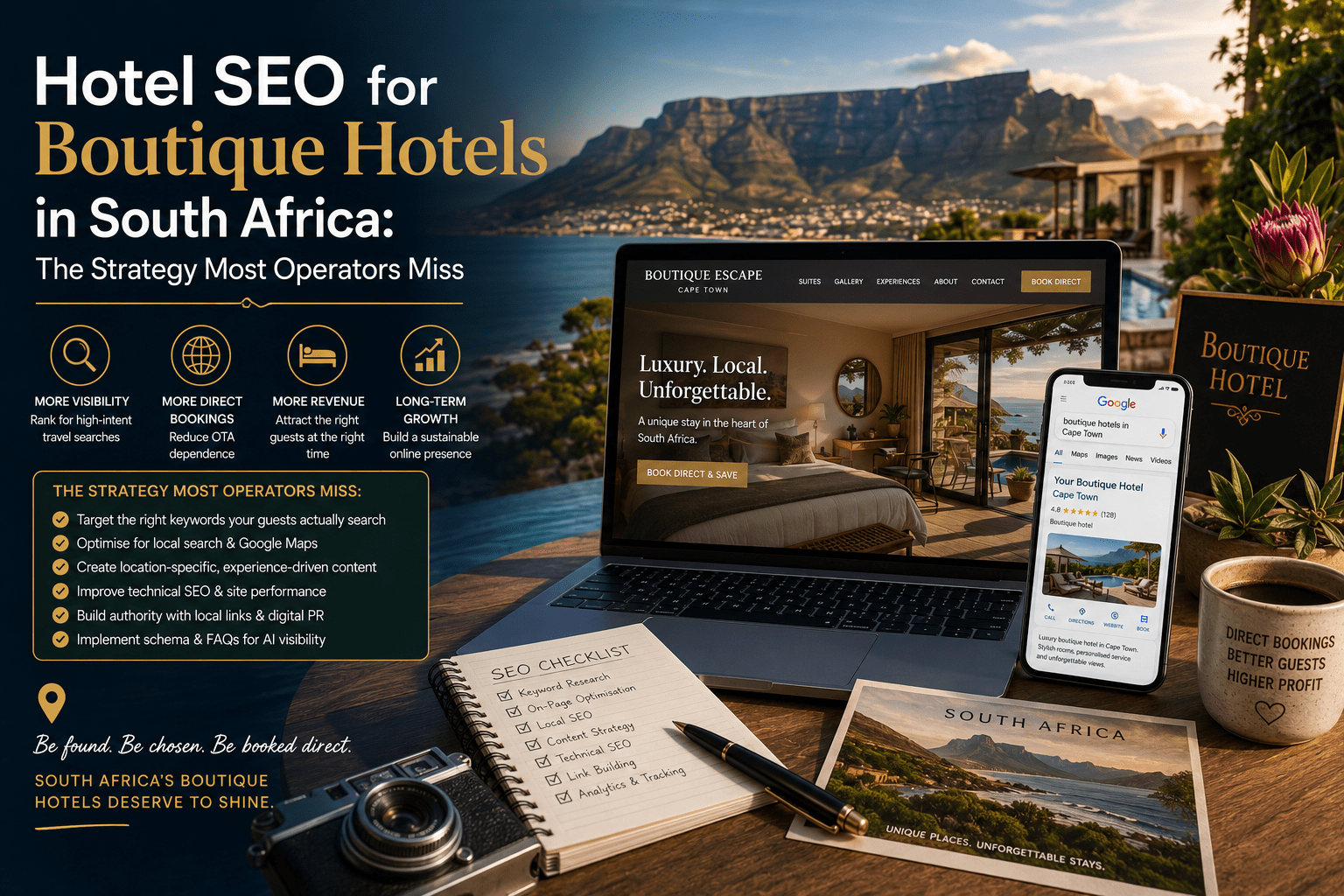
South Africa’s boutique hotel sector is booming — from five-room guesthouses tucked into Franschhoek vineyards to restored Karoo farmhouses and cliff-edge suites along the Garden Route. Yet the operators behind these properties are, almost universally, losing revenue to online travel agencies (OTAs) that outspend and outrank them on Google every single day.
The irony is sharp: a boutique hotel’s greatest competitive advantage — its individuality, its sense of place, its story — is precisely what a well-executed hotel SEO strategy can amplify online. But most boutique operators are either ignoring SEO entirely, or applying a one-size-fits-all approach designed for chain hotels with full marketing departments.
This guide unpacks the specific, hyper-local hotel SEO tactics that boutique properties across South Africa can implement right now to grow direct bookings, reduce OTA dependency, and own their search rankings in 2025 and beyond.
Why Boutique Hotels in South Africa Face a Unique SEO Challenge
Large hotel groups can afford dedicated digital marketing teams, agency retainers, and six-figure Google Ads budgets. Boutique properties typically cannot. This means organic SEO is not just a nice-to-have for smaller accommodation providers — it is the single highest-ROI marketing channel available to them.
The challenge is this: most boutique hotels sit in destinations rather than cities. They are not competing for ‘hotels in Cape Town CBD’ — they are competing for searches like ‘romantic guesthouses in Hermanus’, ‘farm stays near Stellenbosch’, or ‘dog-friendly accommodation Garden Route’. These are longer, more specific queries (often called long-tail keywords) that Google’s algorithm treats very differently from broad city-level searches.
The good news? Long-tail destination queries are far less competitive. A boutique hotel with a focused hotel SEO strategy for South Africa can realistically rank on page one within 3–5 months for these terms — without needing the domain authority or budget of Booking.com.
The Four Pillars of Boutique Hotel SEO in South Africa
1. Hyper-Local Keyword Targeting: Beyond ‘Hotels Near Me’
Most boutique hotel websites target generic keywords (‘accommodation South Africa’, ‘guesthouses Cape Town’) that are too broad to win and too vague to convert. The highest-intent travellers — the ones ready to book — are searching for specific combinations of location, experience, and property type.
Effective keyword targeting for South African boutique properties means building content around:
- Neighbourhood and micro-destination phrases: ’boutique hotel Franschhoek village’, ‘guesthouse near Boulders Beach’, ‘lodge Cederberg wilderness’
- Experience-led queries: ‘wine tasting accommodation Stellenbosch’, ‘whale watching guesthouse Hermanus’, ‘birding lodge Kruger buffer zone’
- Occasion-specific searches: ‘anniversary getaway Western Cape’, ‘solo traveller-friendly guesthouse Garden Route’, ‘family lodge with pool Magaliesberg’
- Seasonal modifiers: ‘summer accommodation Wilderness’, ‘Namaqualand flower season lodges’
Each of these keyword clusters should have its own dedicated page or blog post on your website — not a single homepage trying to rank for all of them simultaneously.
2. Google Business Profile Optimisation: The Most Underused Tool in Hospitality
For boutique hotels outside of major cities, Google Business Profile (GBP) is often more powerful than the hotel website itself. When a traveller searches for accommodation in a specific area, Google Maps results (the ‘Local Pack’) appear before organic results on both desktop and mobile.
Yet the majority of South African boutique hotels have incomplete or unmanaged GBP listings. Common gaps include:
- No regular posting schedule (Google rewards active profiles)
- Missing room photos, amenity photos, and exterior images uploaded in the last 90 days
- Unanswered guest reviews (both positive and negative)
- Incorrect or missing category selections (e.g., missing ‘bed and breakfast’, ‘lodge’, or ‘guesthouse’ as secondary categories)
- No Q&A section populated with pre-answered questions about check-in, pets, parking, and Wi-Fi
If your hotel is not appearing prominently in Google Maps searches, the fix is rarely technical — it is almost always a matter of profile completeness and ongoing management. Our guide on why your hotel doesn’t appear on Google Maps walks through the exact steps to resolve this.
3. Winelands Accommodation SEO: A Case Study in Destination Content
The Cape Winelands — encompassing Stellenbosch, Franschhoek, Paarl, and surrounding wine estates — is one of South Africa’s most searched accommodation destinations among both domestic and international travellers. It is also one of the most competitive.
Boutique properties in this region that rank on page one share one thing in common: destination-rich content. This means their websites do not simply describe the property — they describe the destination. Google’s algorithm increasingly rewards what SEOs call ‘topical authority’: the more comprehensively your website covers the topic of ‘Winelands accommodation’, the more trust Google places in your rankings.
For a Winelands boutique hotel, this looks like:
- A dedicated ‘Stellenbosch Winelands’ page optimised for accommodation searches in the area
- Blog content covering experiences: ‘The 7 Best Wine Routes from Franschhoek’, ‘Where to Stay During Harvest Season in the Winelands’
- Structured data (Schema markup) for your property type, price range, check-in/out times, and amenities
- Internal links connecting your experience content back to your booking or enquiry page
This approach — what we call hotel content marketing for South Africa — creates a compounding SEO effect. Each piece of content builds authority for the next.
4. Direct Bookings South Africa: Converting SEO Traffic into Revenue
Ranking on Google is only half the equation. The other half is converting that traffic into direct bookings — without losing the guest to an OTA at the final moment.
The most common conversion failure points on boutique hotel websites in South Africa are:
- No real-time availability widget or booking engine on the homepage
- Rate parity with OTAs (if the same room costs the same on Booking.com, guests have no reason to book direct)
- Slow mobile load times (Google’s Core Web Vitals directly affect both rankings and booking conversion rates)
- No direct booking incentive: complimentary early check-in, welcome drink, or room upgrade for guests who book via the website
South African boutique hotels that offer even a modest direct booking incentive — combined with a fast, mobile-optimised website and a clear ‘Book Direct’ CTA — typically see 20–35% higher direct booking rates within six months of implementing these changes.
The detailed breakdown of why guests default to OTAs and how to reverse this is covered in our post on why your hotel isn’t getting direct bookings.
Schema Markup: The Technical Edge Most Boutique Hotels Ignore
Structured data (Schema.org markup) tells Google precisely what type of business you are, what amenities you offer, your price range, your location, and your review rating. For boutique hotels, this is particularly powerful because it enables rich results in Google Search — star ratings, price ranges, and check-in times displayed directly in the search result before a guest even visits your site.
The key Schema types for South African boutique hotels are:
- LodgingBusiness (or its subtypes: BedAndBreakfast, Resort, Hotel)
- LocalBusiness with geographic coordinates
- Review and AggregateRating from verified guest review platforms
- FAQPage for commonly asked pre-booking questions
Most boutique hotels either have no Schema markup, or have it incorrectly implemented. Fixing this alone can produce measurable improvements in click-through rates from Google within 4–8 weeks.
The Link Between Local SEO and OTA Displacement in South Africa
Online travel agencies maintain their page-one dominance through three factors: massive domain authority, aggressive paid search spending, and content volume. Boutique hotels cannot compete on the first two — but they can compete on the third, and they hold one advantage OTAs never will: a physical presence in the destination.
Local SEO leverages this physical presence. Google’s local search algorithm weights proximity, relevance, and prominence — and a boutique hotel in Knysna will always have a proximity advantage over a Booking.com listing page for ‘accommodation in Knysna’. The opportunity is to combine that geographic advantage with consistent content, citations, and GBP management.
For a structured framework on why local SEO is the most important long-term strategy for South African accommodation providers, our comprehensive guide on why Cape Town hotels need local SEO to win more direct bookings provides a step-by-step breakdown applicable to boutique properties across the country.
Where to Start: A 90-Day Hotel SEO Roadmap for South African Boutique Properties
Days 1–30: Audit and Foundation
- Complete a technical SEO audit (site speed, mobile usability, crawl errors, duplicate content)
- Claim, complete, and verify your Google Business Profile
- Identify 15–25 long-tail destination keywords specific to your property and location
- Install Schema markup for your property type
Days 31–60: Content and On-Page Optimisation
- Create or optimise your location landing page with primary keyword, local context, and nearby attractions
- Publish two destination-focused blog posts targeting experience-led search queries
- Ensure all meta titles and descriptions across your site include location + property type
- Build citations on South African directories: SA Tourism, Nightsbridge, Travelstart, Portfolio Collection
Days 61–90: Authority and Conversion
- Launch a ‘Book Direct’ incentive and ensure it is prominently featured on your homepage and booking flow
- Begin a structured GBP posting schedule (minimum twice per week)
- Pursue backlinks from local tourism bodies, wine route associations, or national park visitor guides
- Measure and report on keyword ranking improvements, organic traffic growth, and direct booking rate
For the complete technical checklist of what your hotel website needs to rank and convert, the hotel SEO checklist that drives more reservations in South Africa covers every element in detail.
Frequently Asked Questions
How is boutique hotel SEO different from large hotel SEO?
Boutique hotel SEO focuses on long-tail, destination-specific keywords, hyper-local content, and Google Business Profile optimisation rather than broad city-level keyword competition. Boutique properties have the advantage of authenticity and physical location — local SEO amplifies this.
How long does it take for a South African boutique hotel to rank on Google?
For long-tail destination keywords with low to medium competition, most boutique hotels see page-one rankings within 3–5 months of implementing a focused SEO strategy. Google Business Profile improvements (appearing in Maps) can happen faster — often within 4–8 weeks of profile optimisation.
Do I need to blog to rank on Google as a boutique hotel?
Not exclusively — but experience-led and destination-focused content is one of the fastest ways to build topical authority and capture long-tail search traffic. Even 4–6 well-written, keyword-targeted blog posts per year can produce significant organic traffic growth for boutique properties.
What is the best way to reduce OTA dependency for a small South African hotel?
The combination of strong organic SEO (so guests find you directly), a live booking engine on your website, a clear direct booking incentive, and active Google Business Profile management produces the most consistent reduction in OTA reliance. This is a 6–12 month process, not an overnight fix.
Ready to grow your boutique hotel’s direct bookings through SEO? Get your free hotel SEO audit here — no obligation, delivered within 48 hours.
