
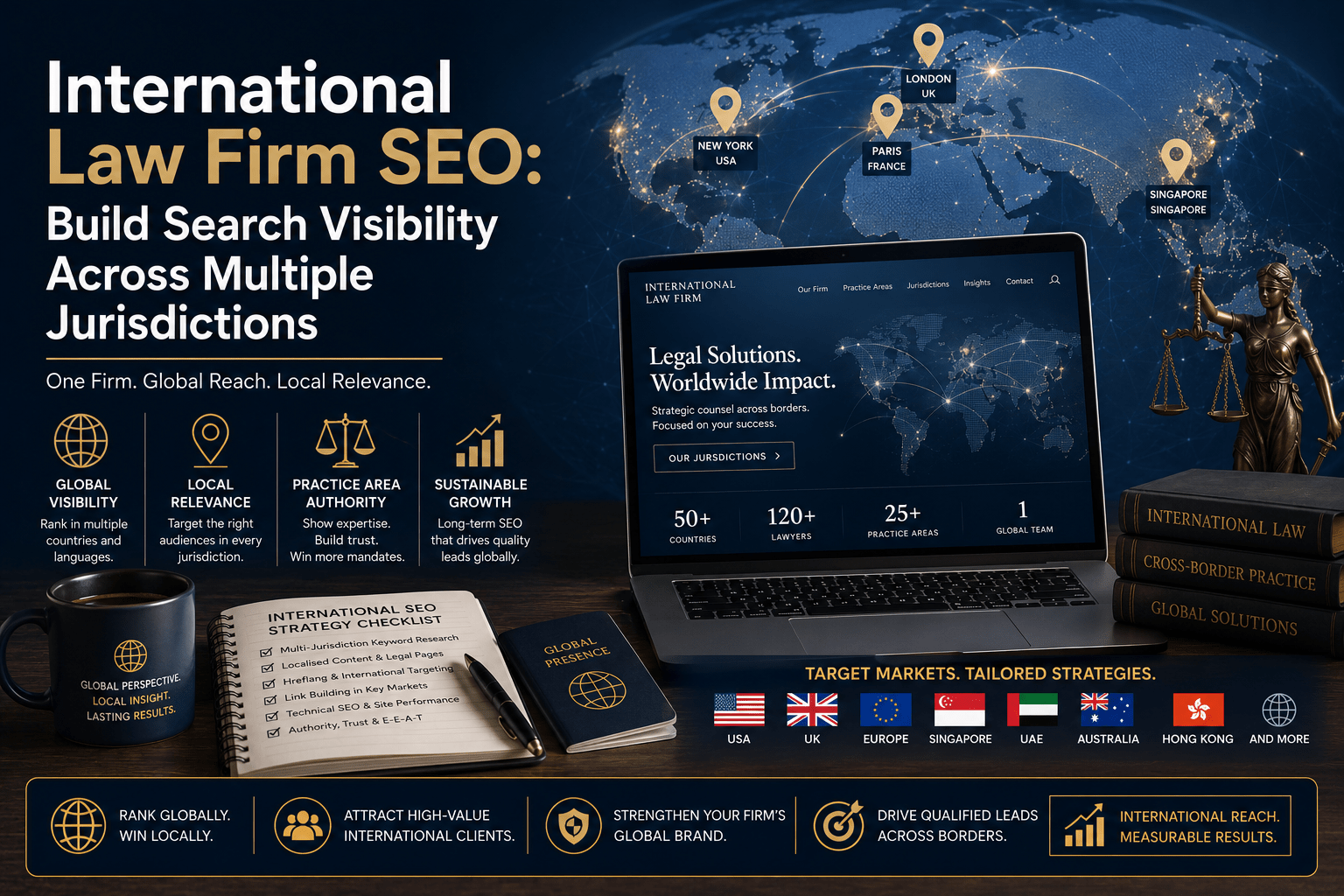
The Multi-Jurisdiction SEO Problem Most Law Firms Get Wrong
A commercial litigation firm serves clients in London, New York, and Singapore. Their website is one domain, built primarily for the UK market. Their content mentions “English law” throughout. Their Google Business Profile lists a single London address.
When a Singapore-based company searches for “commercial litigation lawyer data breach Singapore,” this firm does not appear. When a New York GC searches “cross-border M&A counsel,” they find US firms. When someone in Dubai searches in English for international arbitration support, this firm’s strongest cases, resolved across three jurisdictions, are invisible.
This is the multi-jurisdiction SEO problem. It is not a lack of expertise. It is a structural failure in how the firm’s digital presence is organised. This guide provides the architecture, content strategy, and technical framework that allows law firms to build genuine law firm SEO visibility across multiple jurisdictions without creating a fragmented, duplicate-content mess that undermines overall authority.
Why International Legal SEO Is Categorically Different
Search intent varies by jurisdiction — even for the same query. “Unfair dismissal lawyer” in the UK implies employment tribunal proceedings under the Employment Rights Act 1996. The same phrase in Australia triggers a different legal framework (Fair Work Act 2009), different processes, and different remedies. Content that conflates these will fail to satisfy either market’s search intent.
Local search algorithms weight geographic proximity signals heavily. Google’s local ranking factors: proximity, relevance, and prominence are calibrated to surface geographically relevant results. A UK firm without a US Google Business Profile, US-specific content, and US-targeted technical signals will not appear in US local search results, regardless of their global reputation.
Legal terminology differs across common law and civil law systems. SEO for a firm advising clients under French civil law requires entirely different keyword research than SEO for English common law advisory work. Clients in each jurisdiction use different search vocabulary, a fact that most generic law firm SEO strategies fail to account for.
The Architecture: How to Structurally Organise a Multi-Jurisdiction Law Firm Website
The most consequential decision in international law firm SEO is site architecture. There are three options, each with distinct trade-offs.
Option 1: Country-Code Top-Level Domains (ccTLDs)
Example: firmname.com (US), firmname.co.uk (UK), firmname.com.au (AU)
Pros: Strongest geographic signal to search engines. Each domain builds independent domain authority for its market.
Cons: Authority is fragmented across multiple domains. SEO investment must be replicated per domain. Content management complexity increases significantly.
Best for: Firms with genuinely distinct brand presences in each market, sufficient SEO budget to build three separate authority engines, or where local brand differentiation is a competitive requirement.
Option 2: Subdomain Structure
Example: uk.firmname.com, us.firmname.com, sg.firmname.com
Pros: Geographic signals are clearer than subfolders. Easier to manage than separate domains. Some authority transfers from the root domain.
Cons: Google historically treats subdomains as separate entities, authority is less consolidated than subfolders. Requires careful hreflang implementation.
Best for: Mid-sized firms with 2–4 key markets and a strong root domain authority they want to partially leverage.
Option 3: Subfolder Structure (Recommended for Most Firms)
Example: firmname.com/uk/, firmname.com/us/, firmname.com/sg/
Pros: All SEO authority consolidates on a single domain. One technical SEO investment benefits all market pages. Most practical to manage.
Cons: Requires rigorous hreflang implementation to avoid content serving the wrong market. Requires distinct, non-duplicate content per geography.
Best for: Most international law firms, particularly those building from a single strong market base and expanding. This is the architecture we recommend for the majority of our clients.
Content Strategy: Writing for Multiple Jurisdictions Without Creating Duplicate Content
The most common mistake in multi-jurisdiction legal SEO is republishing the same content with different country names inserted. This creates thin, duplicate content that Google demotes and it fails clients who need jurisdiction-specific legal insight. Effective multi-jurisdiction content is substantively distinct, not superficially localised.
The Practice Area Hub Model
A global overview page: Establishes your firm’s expertise and international capability. Targets broad queries like “international employment law counsel” or “cross-border M&A advisory.” This page does not attempt to rank for jurisdiction-specific queries, it ranks for the firm’s global positioning.
Jurisdiction-specific practice pages: Each major market receives a dedicated page covering the practice area under local law. For employment law, this means separate pages for UK unfair dismissal, US wrongful termination, Australian Fair Work claims, and so on. Each page targets jurisdiction-specific search intent and terminology.
Intersection content: Some of the highest-value legal queries involve cross-jurisdictional issues: “employment law implications of UK-US remote working,” “GDPR compliance for Australian companies with EU clients.” These topics have low competition and high commercial intent, and are unique to your multi-jurisdiction capability.
Jurisdiction-Specific Keyword Research
The keyword research process for each jurisdiction must be conducted independently. Do not translate UK keyword research into US equivalents and assume parity. Conduct fresh research for each market using local search data.
- Legal terminology: “Solicitor” (UK/AU) vs. “Attorney” (US) vs. “Advocate” (South Africa/India)
- Practice area names: “Conveyancing” (UK/AU) vs. “Real estate law” (US)
- Procedural vocabulary: “Barrister,” “Queen’s Counsel,” “tribunal” have no US equivalents. US clients search differently for the same concepts
- Query volume distribution: High-volume generic terms in the US may be low-volume in smaller markets; long-tail queries in niche markets may be the highest-value traffic available
Technical SEO for Multi-Jurisdiction Sites
Technical implementation is where most international legal websites fail. The following elements are non-negotiable.
Hreflang Implementation
Hreflang attributes tell Google which version of a page to serve to users in which country and language. Without correct hreflang, Google may serve UK users your US page, or index the wrong version for each market. This is one of the most common technical failures we identify in law firm SEO audits.
Correct hreflang implementation requires: a self-referencing hreflang tag for each page, tags for every localised variant, an x-default fallback tag, and identical hreflang sets on all variant pages pointing to each other.
Google Business Profile Management
A Google Business Profile (GBP) is mandatory for local search visibility in each market where your firm has a physical office. Multi-location firms must:
- Create and verify a GBP listing per office location
- Maintain consistent Name, Address, Phone (NAP) data across all platforms, inconsistency is a local ranking penalty
- Publish office-specific content: local case outcomes (anonymized), jurisdiction-specific resources, and local legal updates
- Collect and respond to reviews per location. Review velocity and quality are significant local ranking factors
Geo-Targeting in Google Search Console
For subfolder and subdomain architectures, configure international targeting in Google Search Console. Set the target country per subfolder section. This is a direct, manual signal that reinforces your hreflang implementation.
Canonical Tag Management
Every localised page must include a self-referencing canonical tag pointing to itself, not to the global parent page. Incorrect canonicals are one of the most common causes of multi-jurisdiction SEO failures. If you have noticed your law firm website isn’t generating leads despite strong content, incorrect canonicals cross-jurisdiction are a frequent root cause.
Building Local Authority in Each Target Market
Domain authority from your primary market does not automatically transfer to new geographic markets. Each market requires dedicated authority-building activity.
Local Backlink Acquisition
Target authoritative links from within each target jurisdiction. For a deep understanding of link-building strategy, see our guide on high-authority backlink strategies for criminal defense lawyers, the same principles of legal niche authority-building apply globally.
- UK: The Law Society, Legal 500, Chambers and Partners, The Lawyer, Legal Week, regional bar associations
- US: Martindale-Hubbell, Avvo, Above the Law, American Bar Association publications, state bar association directories
- Australia: Law Council of Australia, Lawyers Weekly, Australian Legal Practice Management Association
- Global: International Bar Association, Chambers Global, Who’s Who Legal
Local Content Partnerships
Guest commentary in jurisdiction-specific legal publications builds authority and generates the kind of off-page brand signals that AI citation algorithms register. A family law partner contributing an article on financial settlements under Scottish law to a Scottish legal publication is worth significantly more to Scottish search visibility than a generic guest post on a legal aggregator.
Regional PR and Media Engagement
When your firm takes a notable case, secures a significant outcome, or a partner speaks at a regional legal conference, ensure this activity is documented with geo-tagged press releases and media outreach to local legal news outlets. These mentions accumulate as local authority signals over time.
Measuring Multi-Jurisdiction SEO Performance
Configure Google Search Console per country. Use the Country filter in the Performance report to analyse impressions, clicks, and average positions by market. A page gaining UK traffic while losing US impressions requires different diagnoses and different responses.
Track rankings per jurisdiction independently. Rank tracking tools allow you to specify the target country and search engine for each tracked keyword. Ensure your reporting segments results by market, a single aggregate ranking report is insufficient.
Attribute enquiries by source market. If your intake process captures the prospect’s location, segment this data by market in your CRM. Understanding which markets generate the highest-value enquiries allows you to prioritise SEO investment accordingly.
Measure cost per enquiry against paid alternatives per market. In some jurisdictions, paid search costs in legal are extremely high (US legal CPC averages can exceed $500 for competitive terms). In others, paid competition is lower. This variation makes the ROI calculation for law firm SEO investment market-specific.
FAQ: International Law Firm SEO
What is the best website structure for a law firm with offices in multiple countries?
For most international law firms, a subfolder structure on a single domain, such as firmname.com/uk/, firmname.com/us/ — is the recommended approach. It consolidates domain authority, reduces technical complexity, and requires only one primary SEO investment to benefit all markets. Our definitive guide to law firm SEO covers the technical architecture of authority-building in depth.
Do I need separate Google Business Profiles for each office location?
Yes. A Google Business Profile must be created and verified for each physical office location. Without a verified GBP in each market, your firm cannot appear in Google’s local Map Pack, the most prominently displayed result for location-based legal queries such as “commercial lawyer near me” or “employment law firm [city].”
How do I avoid duplicate content penalties with multi-jurisdiction content?
Avoiding duplicate content requires substantively distinct content per jurisdiction, not just localised replacements of country names. Each jurisdiction-specific page should address the relevant local laws, procedures, terminology, and client concerns that are unique to that market.
How long does it take to build search visibility in a new international market?
Building search visibility in a new market typically takes 6–12 months for meaningful results and 12–24 months for competitive keyword rankings. The timeline depends on the domain’s existing authority, the competitiveness of the local legal market, and the pace of local content publication and link acquisition.
Can my law firm rank in international markets without a local office?
It is possible to rank organically for informational and advisory queries in markets where you have no physical office, particularly for cross-jurisdictional topics where physical presence is less relevant. However, ranking in the local Map Pack requires a verified physical address. Firms without local offices should focus on organic rankings, GBP service-area listings where available, and content targeting cross-border query intent.
What is hreflang and why does my international law firm website need it?
Hreflang is an HTML attribute that tells Google which version of a page to serve to users in specific countries or language regions. Without hreflang, Google may serve UK users your US page, or index the wrong version for each market, causing ranking failures across all jurisdictions. Correct hreflang implementation is a technical prerequisite for any multi-jurisdiction website.
Conclusion: Treating Each Market as a Distinct Search Ecosystem
The law firms that successfully build international search visibility share one characteristic: they treat each jurisdiction as a separate search ecosystem with its own clients, terminology, competition, and authority signals, while centralising the technical and brand infrastructure that serves all markets.
The architecture decisions made early, domain structure, hreflang implementation, GBP strategy, determine whether a multi-jurisdiction law firm SEO programme compounds efficiently or creates fragmented, competing signals. Getting these foundations right before investing in content and link building is the difference between a programme that scales and one that stalls.
For law firms with genuine multi-jurisdictional capability, a well-executed international SEO programme is a durable competitive advantage. It builds the kind of global visibility that referrals cannot provide and paid advertising cannot sustain.
Operating across jurisdictions and want to make your global capability visible in search? Request a free international SEO audit from LiquidMash.
LiquidMash provides AI-powered SEO and GEO services for law firms globally across North America, UK, Europe, Australia, Africa, Asia-Pacific, and the Middle East. Our international SEO strategies are built for sustainable, multi-market authority.
