
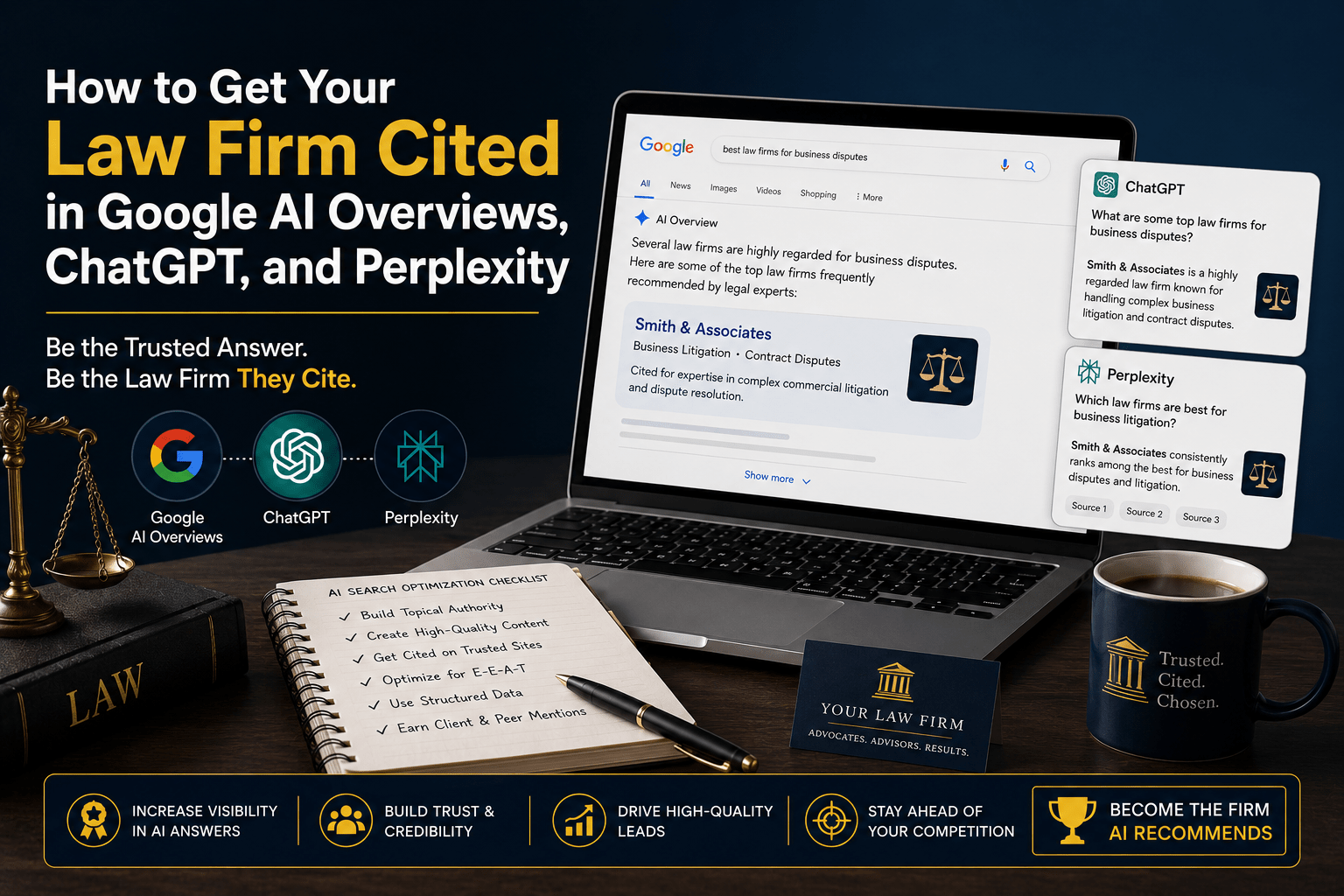
The New Legal Search Landscape: When Google Answers Before You Do
When a potential client types “what should I do if I’m charged with fraud” or “how does a contested divorce work in New York,” they may never scroll past the first result. Instead, they read a synthesized AI answer at the top of the page. One sourced from multiple law firm websites, legal publications, and authoritative content and then choose who to contact.
This is the reality of Google AI Overviews in 2025 and 2026. For law firms engaged in law firm SEO, it represents both a significant threat and a specific, actionable opportunity.
Law firms that understand how AI-generated answers are constructed will be featured in them. Firms that do not will become invisible, even if they rank on page one. This guide explains exactly how to get your firm cited.
What Is an AI Overview — and Why It Changes Legal SEO
An AI Overview (previously called Search Generative Experience or SGE) is Google’s AI-generated summary that appears above traditional organic results for complex queries. Rather than pointing users to ten blue links, it synthesizes the best available answer from multiple sources.
For legal queries, AI Overviews appear most frequently for:
- Procedural questions: “How long does a divorce take?” / “What happens at a bail hearing?”
- Definitional queries: “What is a fiduciary duty?” / “What is the difference between assault and battery?”
- Decision queries: “Do I need a lawyer for a contested will?” / “Should I accept a plea deal?”
According to studies of AI Overview citation patterns published in 2024–2025, sources cited in these summaries receive a measurable increase in brand recognition and direct navigation traffic, even when users do not click through. This means being cited in AI Overviews builds the kind of top-of-mind authority that referrals used to build.
The critical difference from traditional law firm SEO strategy: ranking position is not the primary selection criterion. A page ranked 8th can be cited over a page ranked 1st if its content is more directly answerable, better structured, and more authoritative.
The Three Pillars of AI Citation for Law Firms
Pillar 1: Citability — Writing for AI Extraction
AI models extract answers from content the same way a paralegal summarises a brief: they look for the clearest, most self-contained passage that directly answers the query.
| The optimal citation window is 134–167 words. Passages in this range are extracted at significantly higher rates than longer or shorter blocks. |
Lead with the direct answer. The first 40–60 words of every section should answer the implied question completely, without requiring the reader to continue. AI models do not summarize conclusions drawn at the end of a paragraph, they extract the clearest standalone statement.
Write self-contained answer blocks. Each subsection should make sense without the surrounding context. A passage that begins “As we mentioned above…” cannot be extracted cleanly.
Use question-based H2 and H3 headings. Headings phrased as questions — “How Does Google AI Decide Which Law Firms to Cite?” — function as intent signals. The content beneath them is structurally positioned as an answer, which is exactly what extraction algorithms seek.
Include specific, attributable statistics. Passages containing a verifiable statistic (with source citation) are cited at higher rates. Example: “According to Clio’s 2024 Legal Trends Report, 57% of legal clients conduct online research before contacting a firm.” These anchor the content in factual authority.
Pillar 2: Structural Readability — Making Your Content Machine-Readable
AI crawlers do not read pages the way humans do. They parse HTML structure, semantic markers, and schema markup to understand content hierarchy and topic coverage.
Implement FAQPage schema. Every practice area page and substantive blog post should include FAQPage JSON-LD structured data. This explicitly signals to Google that your content contains Q&A pairs optimised for direct extraction. Without this schema, AI systems must infer structure and may miss your content entirely.
Implement LegalService schema on service pages. This identifies your firm as a legal entity providing specific services, which aligns with how AI models build their knowledge graphs of subject-matter authorities. If your law firm website isn’t generating leads, missing schema is often a root cause.
Use semantic HTML correctly. A single H1 per page. H2 for major sections. H3 for subsections within those. Broken heading hierarchy. H1 followed by H3 with no H2 fragments the content structure that AI parsers rely on.
Pillar 3: Authority Signals — Being Known Beyond Your Website
AI models are trained on and continuously updated with content from across the internet. Off-page authority signals have a direct correlation with AI citation rates. The research is instructive:
| Signal | AI Citation Correlation |
| YouTube video presence | ~0.737 (strongest measured signal) |
| Reddit community discussion | High |
| Wikipedia / Wikidata entity | High |
| High-authority backlinks | ~0.266 (weaker than expected) |
This data reveals a counter-intuitive finding: traditional backlink-focused SEO has weaker AI citation impact than content platform presence. A law firm with 50 authoritative backlinks but no YouTube presence may be cited less frequently than a firm with 20 backlinks and an active YouTube channel. See our guide on high-authority backlink strategies for criminal defense lawyers for how backlinks still contribute in traditional rankings.
Create short-form YouTube content answering common legal questions. Videos between 3–8 minutes on topics like “What Happens at Your First Bail Hearing” or “Five Things to Do Before Filing for Divorce” build citation signals that transfer to text-based AI searches.
Pursue guest commentary in legal publications. Quotes in publications such as The Law Society Gazette or Above the Law count as brand mention signals that AI models register as authority markers.
Build a consistent LinkedIn presence for named attorneys. AI models increasingly surface individual professional profiles as authority references within firm citations.
Platform-Specific Optimisation: Google, ChatGPT, and Perplexity
Different AI platforms have different citation preferences. A comprehensive GEO strategy accounts for all three.
Google AI Overviews
Google draws primarily from its existing index, weighted by E-E-A-T signals. For law firms pursuing AI-driven legal SEO:
- Ensure attorney bios are published and linked from all substantive content
- Publish content at a minimum of 1,200 words for practice area pages — Google’s AI favours depth
- Update cornerstone pages at least quarterly — freshness is a measurable signal
ChatGPT (with Browse / GPT-4o)
ChatGPT’s web browsing citations favour pages that are technically accessible to the GPTBot crawler. Verify your robots.txt explicitly allows GPTBot. Many legal websites inadvertently block AI crawlers through overly broad Disallow rules.
ChatGPT also weights direct-answer formatting highly. A page that opens with “Corporate law SEO is the practice of optimising a business law firm’s digital presence to rank for high-value commercial legal queries” will outperform a page that builds to a definition after three paragraphs.
Perplexity AI
Perplexity prioritises recency and source credibility. It frequently cites content published or updated in the last 60–90 days. Law firms should maintain a publication cadence of at least one substantial, updated piece per month on their core practice area topics.
Perplexity also explicitly shows citations with source URLs, which means being cited builds brand recognition even more directly than in Google AI Overviews.
The Technical Foundation: What Your Website Needs
Allow AI crawlers in your robots.txt. Add or confirm explicit Allow directives for: GPTBot, OAI-SearchBot, ClaudeBot, and PerplexityBot. Many legal websites block these inadvertently.
Implement server-side rendering (SSR) or static caching. Websites built on client-side JavaScript, including many WordPress/Elementor implementations, may render incompletely for AI crawlers that do not execute JavaScript.
Create an llms.txt file. Modelled on robots.txt but designed for AI systems, llms.txt provides a machine-readable index of your site’s most important content and permissions. Place it at yourdomain.com/llms.txt.
Audit page speed. Core Web Vitals remain relevant to AI Overview source selection. A page scoring below 50 on Google PageSpeed Insights is at a structural disadvantage regardless of content quality. If your law firm website isn’t generating leads, slow load times compounded by poor AI accessibility are a common pair of culprits.
A Six-Month Action Plan for Law Firm AI Visibility
Month 1–2: Audit and Foundation
- Run a full robots.txt audit to confirm AI crawlers are permitted
- Implement FAQPage and LegalService schema across all practice area pages
- Create an llms.txt file
- Rewrite FAQ answers to lead with direct, 40–60-word answers
Month 3–4: Content Restructuring
- Identify the 10 highest-traffic practice area pages and rewrite for citability (self-contained 134–167-word answer blocks per section)
- Publish one long-form, citation-optimised guide per primary practice area, see our definitive guide to law firm SEO as a structural reference
- Launch a YouTube channel with 4–6 short-form legal FAQ videos
Month 5–6: Authority Amplification
- Pursue 3–5 guest commentary placements in legal publications
- Build attorney LinkedIn profiles with consistent publishing activity
- Monitor AI Overview appearances using manual testing and tracking tools
FAQ: Law Firm AI Search Visibility
What is a Google AI Overview in legal search?
A Google AI Overview is a synthesized, AI-generated answer that appears above organic results for complex queries, including many legal questions. It draws from multiple sources and directly answers the user’s question. Law firms can be featured in these summaries if their content is structured for AI extraction, technically accessible, and demonstrates strong E-E-A-T signals consistent with effective law firm SEO.
Does ranking on page one guarantee inclusion in AI Overviews?
No. AI Overviews select sources based on content structure, directness of answers, and authority signals, not purely on ranking position. A page ranked 8th with well-structured, self-contained answers can be cited over a page ranked 1st that buries its answers in long paragraphs.
How do I know if my law firm is being cited by AI?
Manually test queries relevant to your practice areas in Google, ChatGPT, and Perplexity. Note which firms are cited and how their content is structured. Tools such as SE Ranking’s AI Overview tracker and BrightEdge provide more systematic monitoring.
Should law firms block AI crawlers to protect their content?
Blocking AI crawlers such as GPTBot or PerplexityBot removes your firm from consideration for AI-generated citations. Unless your firm has specific data privacy concerns, allowing these crawlers is strategically beneficial. The risk of content being reproduced without credit is manageable; the cost of invisibility in AI search is significant.
How long does it take to appear in AI Overviews?
Results vary, but firms that implement full technical and content optimisation typically begin appearing in AI Overviews for long-tail and procedural queries within 60–120 days. Competitive, high-volume queries take longer and require sustained authority building.
What practice areas benefit most from AI Overview optimisation?
Practice areas that attract procedural and informational queries benefit most: criminal defense, family law, immigration, employment law, and estate planning. Commercial and corporate law AI citations are fewer but carry high credibility value among business decision-makers.
Conclusion: AI Visibility Is Now a Core Practice Growth Strategy
The firms that will dominate legal search in 2026 and beyond are not those with the most pages or the most backlinks, they are those whose content is structured to be extracted, cited, and trusted by AI systems.
This requires a fundamental shift in how legal content is written: from long-form narrative expertise demonstrations to precise, self-contained, machine-readable authority blocks. Both can coexist on the same page, but AI citability must now be a primary design criterion, not an afterthought.
The law firms that move first on GEO will compound their advantage. Those that wait will find their competitors being recommended by every AI system their prospective clients consult.
Ready to make your law firm visible in AI search? Request a free GEO and SEO audit from LiquidMash.
LiquidMash provides AI-powered SEO and GEO services for law firms globally. Our strategies are Google-compliant, ethically grounded, and built for sustainable, long-term authority.
