
From Walk-Ins to Search Dominance: How a Focused Tour Operator SEO Strategy Transformed a Garden Route Adventure Company in 4 Months
The Garden Route is one of South Africa’s most iconic tourism corridors. Dramatic ocean cliffs. Ancient indigenous forests. Adventure experiences that rank among the finest on the African continent.
This activity-based tourism business had all of it.
Ziplining through dense forest canopies. Kayaking along pristine, sheltered estuaries. Guided hikes across breathtaking coastal and mountain terrain. The product was exceptional. The location was world-class. Guests consistently left satisfied, energised, and eager to recommend the experience to friends and family.
But beneath the surface, the revenue model was fragile.
Peak season brought consistent demand and full activity schedules. Off-season brought uncertainty, reduced staffing, and unpredictable cash flow. The business had no reliable mechanism for generating pre-planned, pre-committed bookings from travelers who were still in the planning phase of their trip. Most bookings came from tourists already physically present in the area, foot traffic, word-of-mouth, last-minute decisions made while browsing a local notice board or asking a guesthouse owner for recommendations.
Online, the business was nearly invisible.
This case study explores how a structured tour operator SEO strategy, grounded in a comprehensive tour operator SEO audit, helped this Garden Route adventure business:
- Double website traffic in just 4 months
- Significantly increase Google Maps calls and direction requests
- Grow Google reviews from 14 to 60+ with a 4.8 average rating
- Enter the Local Pack Top 3 for core activity keywords
- Shift from walk-in dependency to predictable, pre-planned online bookings
Most importantly, it helped the business increase search visibility, grow its digital presence, and build a revenue model that didn’t collapse the moment peak season ended. All without paid advertising.
The Starting Point: A Tourism Business With Weak Digital Foundations
Before building any tourism SEO strategy, we assessed the baseline. Understanding where a business stands digitally is the only way to build a strategy that addresses the right problems in the right order and avoids wasting time and budget on tactics that won’t move the needle.
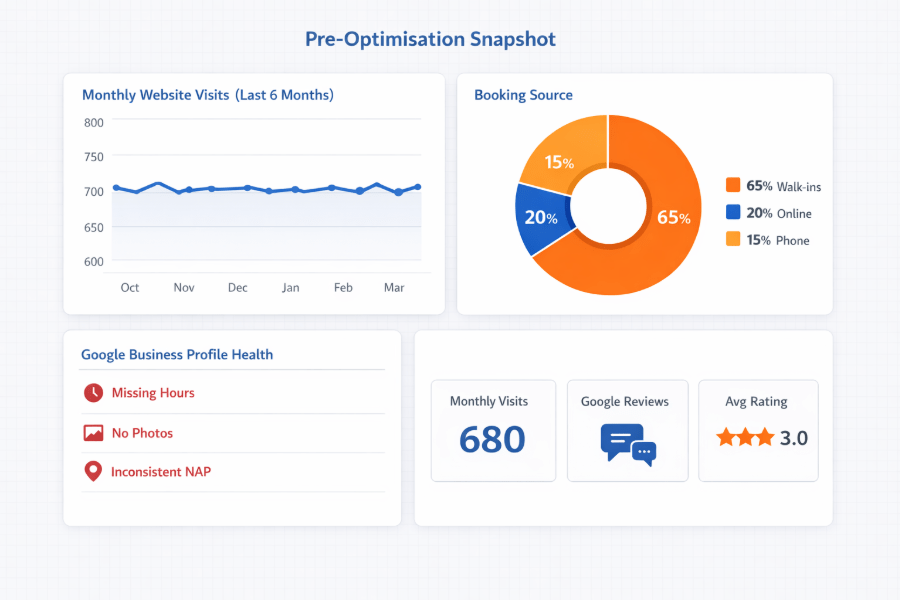
Pre-Optimisation Metrics
- Monthly Website Visits: ±680
- Booking Source Breakdown: 65% walk-ins, 20% online, 15% phone
- Google Reviews: 14 reviews with a 3.9 average rating
- Google Business Profile: Incomplete and largely unoptimised
- Directory Listings: 8 inconsistent citations across major platforms
- Website Structure: A single page listing all activities with no individual landing pages
There was no structured travel SEO framework in place. No keyword targeting. No activity-specific pages. No local search strategy. No content designed to capture demand from travelers in the research and planning phase.
The business was not ranking for any of the high-intent terms that travelers use when planning activities along the Garden Route:
- “ziplining Garden Route”
- “kayaking Garden Route”
- “guided hikes Garden Route”
- “adventure activities Garden Route”
These are not obscure, low-volume searches. These are the exact queries typed by travelers who have already chosen the Garden Route as their destination and are now actively deciding which activities to book. They represent the bottom of the funnel. The highest-converting traffic available to any activity-based tourism business.
Instead, the business’s limited traffic was almost entirely branded. People had to already know the business name to find it. That is not a growth strategy. That is digital stagnation and in a competitive tourism corridor like the Garden Route, it is a vulnerability that compounds over time as better-optimised competitors capture the demand that should be yours.
Why This Was a Revenue Risk — Not Just a Marketing Problem
For tourism businesses, unpredictability is not just uncomfortable. It is financially dangerous.
When revenue depends heavily on walk-ins, weather conditions, random foot traffic, and peak-season overflow, the business has no meaningful control over its own growth trajectory. One slow season, one new competitor opening nearby, one shift in traveler behavior, one bad weather stretch during peak weeks — and the revenue model cracks.
The deeper issue is that this dependency on physical presence and word-of-mouth is not a stable foundation for a modern tourism business. It worked in an era when travelers arrived at a destination and then decided what to do. That era is largely over.
Modern travelers plan ahead. Research consistently shows that the majority of tourists research and book activities before they arrive at a destination, not after. They search online. They compare ratings and reviews. They evaluate photos and inclusions. They look for social proof. They read FAQs. They check pricing. They make decisions based on what they find, or don’t find in search results.
If your business is not visible during that research phase, you have already lost the booking. The traveler has moved on to a competitor who is visible, is ranking, and is capturing that demand. And they will continue to do so every single day that your digital foundation remains weak.
This is precisely where tour operator SEO transitions from a “nice to have” marketing activity into a core revenue lever. It is the mechanism that puts your business in front of high-intent travelers at the exact moment they are ready to book — before they arrive, before they ask a guesthouse owner, and before they walk past a competitor’s signage.
Phase 1: The Tour Operator SEO Audit — Finding the Real Gaps
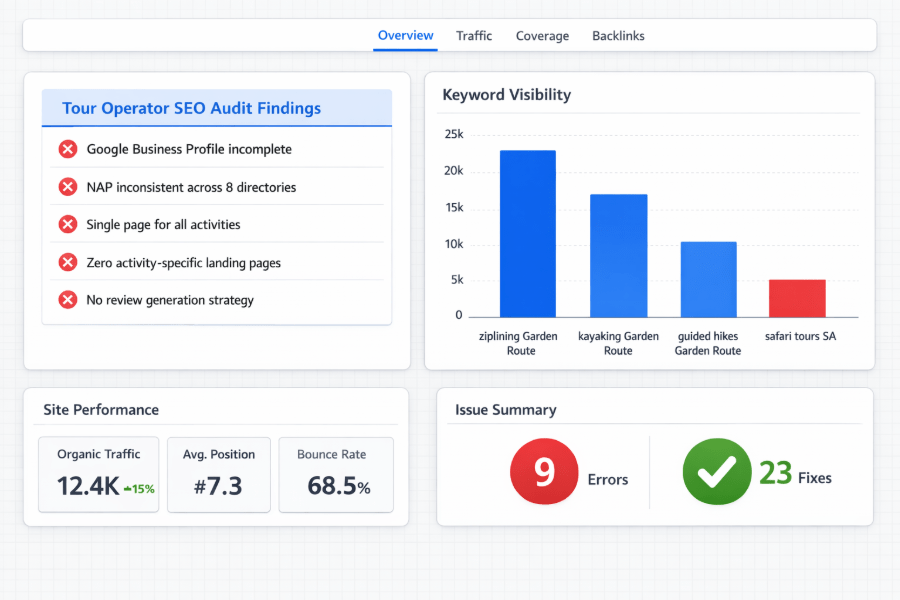
Before a single piece of content was written or a single technical fix was implemented, we conducted a thorough tour operator SEO audit. In tourism SEO, the audit is where the real strategic insight lives. It reveals not just what is broken, but what is being left on the table and why.
Our audit evaluated local SEO signals, on-page structure, keyword visibility, Google Business Profile health, citation consistency, and technical performance across the entire digital footprint.
The findings were significant across every dimension.
Finding 1: Google Business Profile — Untapped Leverage
The Google Business Profile (GBP) was incomplete in almost every meaningful way. Operating hours were missing. The business description contained no relevant keywords. The photo gallery was sparse and outdated. The Q&A section had never been populated. There was no consistent posting activity. Categories were not fully optimised.
For a local tourism business, the GBP is arguably more important than the website itself. It is the first thing a traveler sees when they search for activities in a specific area. It directly influences Google Maps visibility, Local Pack rankings, call volume, and direction requests. It is the digital storefront that appears before a traveler ever reaches your website and it is entirely free to optimise.
Neglecting it is one of the most common and most costly mistakes in marketing solutions for tourism business. Fixing it is often the fastest and highest-ROI action available to any local tourism operator.
Finding 2: Citation Chaos Undermining Local Authority
Across TripAdvisor, Yelp, local tourism boards, and activity booking platforms, the business appeared under slightly different names, phone numbers, and addresses. In some cases, an old phone number was still listed. In others, the business name was abbreviated differently across platforms.
This NAP inconsistency (Name, Address, Phone) is a direct negative signal to Google’s local algorithm. Google cross-references business information across the web to validate legitimacy and relevance. When that information is inconsistent, it creates doubt — and doubt suppresses rankings. Our tour operator SEO audit identified 8 directories with conflicting information, each one quietly undermining the business’s local search authority without the owner ever knowing.
Finding 3: The Single-Page Architecture Problem
All three core activities, ziplining, kayaking, and guided hikes were listed on a single page. From a travel SEO perspective, this is a fundamental structural error that prevents any meaningful keyword ranking.
Each activity represents a distinct search intent. A traveler searching “ziplining Garden Route” is not the same person as someone searching “guided hikes Garden Route.” They have different motivations, different fitness levels, different group compositions, and different booking timelines. By combining all activities onto one page, the business was attempting to rank for all of these terms simultaneously and succeeding for none of them.
Google cannot confidently rank a single page for multiple distinct, high-intent queries. Effective tourism SEO requires aligning page content with search intent. One intent, one page. This is not a complex principle, but it is one that most tourism businesses get wrong.
Finding 4: Review Deficit Limiting Local Pack Visibility
With only 14 reviews and a 3.9 average rating, the business was effectively invisible in the Google Maps Local Pack — the three businesses that appear at the top of local search results and capture the majority of clicks for activity-based queries.
Google’s local algorithm weighs review quantity, recency, average rating, and keyword usage within reviews as significant ranking factors. At 14 reviews and 3.9 stars, the business was not competitive in any of these dimensions. Competitors with 80, 100, or 200+ reviews and 4.7+ ratings were dominating the Local Pack and capturing the bookings that should have been flowing to this business.
Finding 5: Technical Performance Gaps
Beyond the structural and local SEO issues, the audit also revealed technical performance gaps that were quietly suppressing both rankings and conversions:
- Slow mobile load times due to unoptimised images
- Missing structured data markup (no LocalBusiness or TouristAttraction schema)
- Weak meta titles and descriptions that reduced click-through rates from search results
- Poor internal linking that left activity pages isolated from the homepage’s authority
Each of these issues, individually, would have a modest impact. Together, they created a compounding drag on the business’s ability to rank, attract clicks, and convert visitors into bookings.
Phase 2: Building the Tour Operator SEO Strategy
With the audit complete and the gaps clearly mapped, we built a focused tour operator SEO strategy designed around one core objective: predictable revenue. Not viral growth. Not vanity metrics. Consistent, bookable demand flowing in from organic search month after month, season after season.
The strategy was built in four interconnected layers: local foundation, content architecture, review growth, and technical performance. Each layer reinforced the others.
Step 1: Fix Every Citation
We corrected all 8 inconsistent directory listings, standardising NAP data across every tourism directory, local listing, social profile, and booking platform. This is the unglamorous side of tourism SEO, but it is foundational. Consistent citations strengthen local trust signals and directly improve Local Pack rankings. The impact is often felt within weeks of correction, as Google’s local algorithm begins to validate the business’s legitimacy more confidently.
Step 2: Rebuild the Google Business Profile From the Ground Up
We completed every profile field, added 30+ high-quality activity photos showcasing the ziplining, kayaking, and hiking experiences, wrote a keyword-rich business description that naturally incorporated core activity terms, populated the Q&A section with the most common traveler questions, and implemented a weekly GBP posting schedule to signal ongoing activity to Google’s algorithm.
Within weeks, local search traction began to improve. Maps visibility increased. Call volume from Google Maps began to grow. This is consistently one of the fastest wins available in marketing solutions for tourism business — and it costs nothing but time and strategic intent.
Step 3: Create Activity-Specific Landing Pages
We dismantled the single-page architecture and replaced it with dedicated, search-optimised landing pages for each core activity:
- /ziplining-garden-route — targeting “ziplining Garden Route” and related long-tail terms
- /kayaking-garden-route — targeting “kayaking Garden Route” and “sea kayaking Garden Route”
- /guided-hikes-garden-route — targeting “guided hikes Garden Route” and “hiking trails Garden Route”
Each page was built with a clear, conversion-focused structure: a detailed activity description, what’s included, pricing, safety information, FAQs, and a direct booking call-to-action. Structured data markup (TouristAttraction, LocalBusiness) was implemented on each page to enable rich results in Google Search and improve click-through rates from the SERP.
This is the cornerstone of effective tour operator SEO. Matching page content to search intent with precision, so Google can confidently rank each page for the right query and travelers can find exactly what they are looking for without friction.
Step 4: Build a Keyword Map for Future Content
Beyond the three core activity pages, we mapped a set of supporting content opportunities, long-tail queries that could drive additional traffic and reinforce the authority of the core pages:
- “best adventure activities Garden Route for families”
- “Garden Route outdoor activities for groups”
- “what to do in Knysna / Wilderness / Plettenberg Bay”
These were not immediately prioritised. The core activity pages came first, but they formed the roadmap for ongoing travel SEO content development in the months following the initial optimisation phase.
Phase 3: A Systematic Review Growth Strategy
Reviews are not just social proof. In local travel SEO, they are a direct ranking signal. One of the most powerful levers available to a local tourism business. We implemented a consistent, low-friction review generation process that was designed to feel natural rather than pushy.
Methods included:
- A QR code displayed prominently at the activity check-in point, linking directly to the Google review page
- A post-activity SMS follow-up sent within 2 hours of activity completion, thanking guests and including a direct review link
- A friendly verbal reminder from guides at the end of each experience, framed as a genuine request rather than a sales pitch
- A follow-up email for guests who had booked online, sent 24 hours after their activity
The goal was to make leaving a review the path of least resistance for genuinely satisfied guests. Removing every possible barrier between the positive experience and the public review.
Within 4 months:
- Reviews grew from 14 → 60+
- Average rating improved from 3.9 → 4.8
This improvement didn’t just build social proof for prospective guests. It directly strengthened Local Pack rankings, increased click-through rates from Google Maps, and improved the business’s overall credibility in Google’s local algorithm. A 4.8-star rating with 60+ reviews is a fundamentally different competitive position than a 3.9-star rating with 14 reviews in both search rankings and conversion rates.
Phase 4: Technical and On-Page Enhancements
Alongside the structural and content changes, we implemented a series of technical improvements that strengthened both crawlability and conversion performance across the entire site:
- Mobile speed optimisation — compressing images and streamlining code to reduce load times, critical given that the majority of Garden Route travelers research on mobile while already in the destination
- LocalBusiness and TouristAttraction schema — enabling rich results in search and improving how Google understood and categorised each activity page
- Internal linking architecture — building clear pathways from the homepage to individual activity pages, and from activity pages to the booking CTA, reducing the number of clicks required to convert
- Meta title and description optimisation — rewriting every meta tag to incorporate target keywords and improve click-through rates from search results
- Image alt text and file naming — ensuring every image contributed to keyword relevance rather than being invisible to search engines
Each of these changes contributed to a stronger overall tourism SEO foundation — one that compounds over time rather than delivering a single spike and then plateauing.
The Results: 4 Months Later
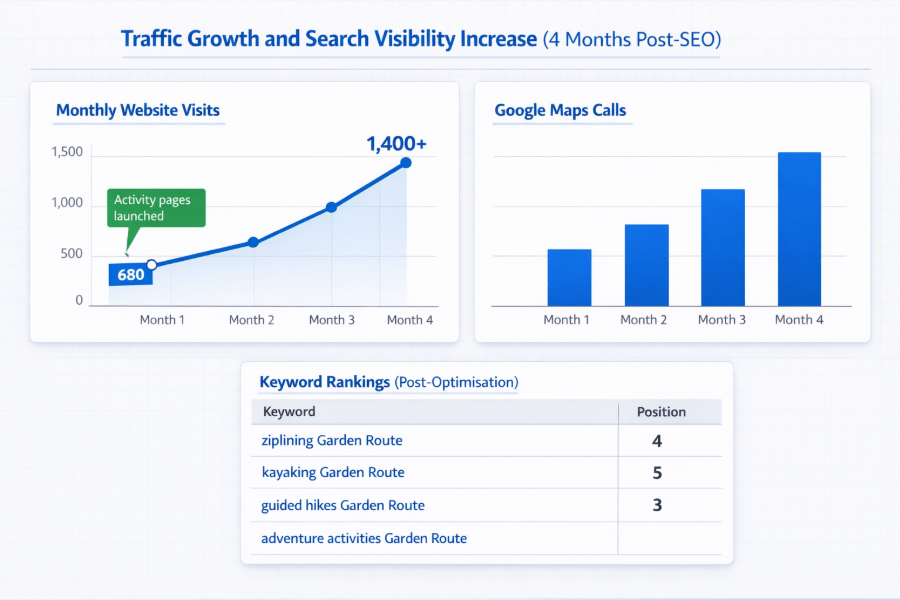
By month four, the compounding effect of every citation fix, every new activity page, every review, and every technical improvement was clearly visible in the data.
Traffic Growth
- Monthly visits grew from 680 → 1,400+
- A 100% increase in organic traffic within 4 months
Keyword Rankings
The business entered the Top 3–5 positions for:
- “Ziplining Garden Route”
- “Kayaking Garden Route”
- “Guided hikes Garden Route”
Local Pack Entry
The business entered the Top 3 Google Maps listings for core activity searches. A position that had previously been occupied entirely by competitors. Calls from Google Maps increased noticeably month-over-month. Direction requests followed.
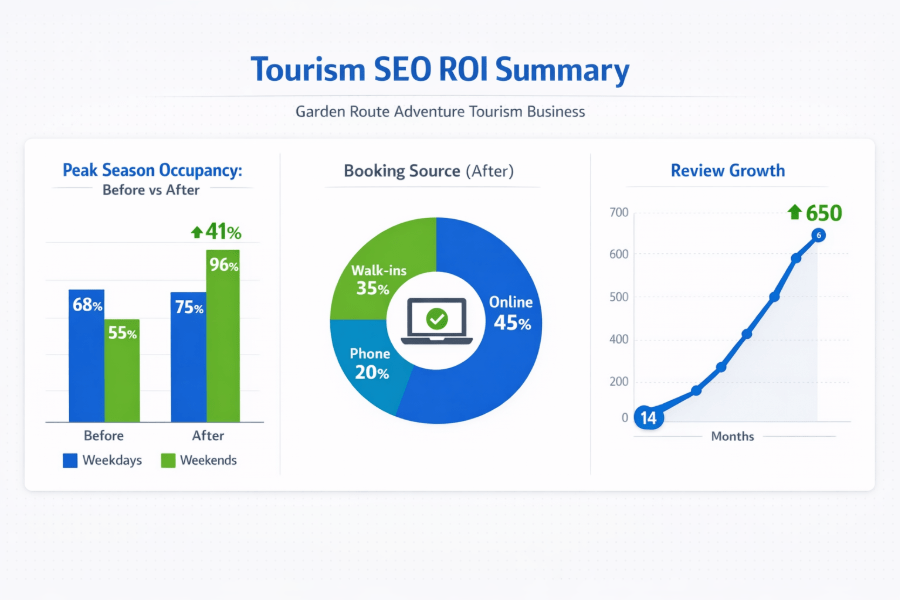
Review Growth
- 14 reviews → 60+ reviews
- 3.9 average → 4.8 average
- Consistent weekly review velocity established
Business Impact: From Fragile to Predictable
The most significant transformation was not the traffic number or the keyword rankings. It was the fundamental shift in how the business operated and how revenue was generated.
Weekends became consistently full during peak months. The booking mix shifted dramatically:
- Walk-ins dropped from 65% → 35%
- Online bookings grew from 20% → 45%
- Peak season weekend occupancy moved from 55% → 95%+
Revenue became predictable. Not explosive, but predictable. And in tourism, predictability is the foundation of sustainable growth. It enables better staffing decisions, better inventory management, better cash flow planning, and a stronger overall business model that is not at the mercy of weather, foot traffic, or seasonal fluctuations.
The business also gained something less tangible but equally valuable: confidence. Confidence that the pipeline would continue to fill. Confidence that the off-season would be manageable. Confidence that growth was no longer dependent on luck or location.

Why This Tour Operator SEO Strategy Worked
1. Intent-Based Page Targeting
Each activity page was built around a specific, clearly defined search intent. Google could match query to page with confidence. Relevance drives rankings and rankings drive revenue. This single structural change unlocked keyword visibility that the business had never had access to before.
2. Local Signals Outperformed Everything Else
For activity-based tourism businesses, local SEO signals like citations, GBP optimisation, and reviews often deliver more ranking impact than expensive link-building campaigns or high-volume content strategies. We focused on the highest-leverage local signals first, and the results reflected that prioritisation.
3. Reviews Are Ranking Fuel, Not Just Social Proof
Most tourism businesses understand that reviews influence guest decisions. Fewer understand that reviews directly influence search rankings. Growing from 14 to 60+ reviews didn’t just improve conversion rates, it improved the business’s position in Google’s local algorithm and unlocked Local Pack visibility that had previously been out of reach.
4. Consistent Execution Builds Compounding Momentum
There was no single “magic fix” in this strategy. The results came from consistent, disciplined execution across citations, GBP, content architecture, review generation, and technical improvements. Each reinforcing the others over time. That is how sustainable tour operator SEO works. Not spikes. Momentum.

The Bigger Lesson for Tourism Businesses
Most tour operators underestimate the role of digital in their revenue model until a slow season forces the conversation.
They rely on foot traffic, referrals, OTAs, and seasonal overflow. These channels work. Until they don’t. And when they stop working, there is no digital foundation to fall back on.
The shift in traveler behavior is not coming. It has already happened. Travelers research before arrival. They book before arrival. They make decisions based on what they find online and if your business is not part of that online conversation, your competitors are.
A strong tour operator SEO strategy is no longer optional for activity-based tourism businesses. It is a core growth engine — one that works 24 hours a day, 7 days a week, in every season, without a paid advertising budget.
Final Statement: Visibility Creates Stability
This Garden Route adventure business didn’t reinvent its product. It didn’t discount its pricing. It didn’t run paid advertising campaigns or chase viral social media moments.
It fixed its digital foundation. It increased search visibility. It grew its digital presence. It built local authority. And revenue followed. Consistently, predictably, and sustainably.
That is the power of strategic tourism SEO when it is built around the right objectives, grounded in a thorough tour operator SEO audit, and executed with discipline over time.
Ready to Build Predictable Revenue for Your Tourism Business?
If your tour operation, activity business, or adventure company currently relies on walk-ins, seasonal overflow, or word-of-mouth alone. You are one slow season away from a revenue problem.
Our travel SEO agency specialises in comprehensive tour operator SEO audits, local search optimisation, activity-specific content strategy, and marketing solutions for tourism business that deliver compounding, long-term results.
Book your free Tour Operator SEO Audit today.
We’ll identify exactly where your business is losing visibility, which keywords your competitors are ranking for, and the precise steps needed to turn your website into your most powerful booking channel.
No fluff. No jargon. Just a clear, actionable roadmap to digital growth.
