
The Challenge: A Polished Website That Nobody Could Find
In the picturesque landscape of Cape Town’s competitive travel industry, having a visually stunning website with beautiful imagery and eloquent brand storytelling means little if your potential customers can’t discover you through organic search. This was the exact predicament facing an established Cape Town travel agency that had built an impressive reputation through years of exceptional service delivery and strong word-of-mouth referrals from satisfied European clients.
Despite their operational excellence and loyal repeat customer base, their digital presence was virtually invisible to the travelers actively searching for their services online. The disconnect between their offline reputation and online discoverability was costing them significant growth opportunities in an increasingly digital-first travel market.
Baseline Performance: The Harsh Reality
When we first engaged with this travel agency, the analytics painted a concerning picture of their digital footprint:
- Organic Traffic: Approximately 3,000 monthly visits—far below their market potential given their service quality
- Bounce Rate: An alarming 68%, indicating visitors weren’t finding the content they expected
- Lead Generation: A mere 20 enquiries per month despite years of industry expertise
- Content Performance: Almost zero traffic to their carefully crafted itinerary pages
- Search Visibility: Virtually non-existent for high-intent travel planning keywords
The website itself was visually impressive. Professional photography, elegant design, and polished brand copy. However, this brand-first approach created a fundamental disconnect with how actual travelers search for and consume travel planning information.
The Critical Error: Brand Language vs. Search Language
The agency’s website exemplified what we term “brand-first content syndrome”. A common mistake where companies prioritize internal marketing language over the actual search terms their customers use. Their copy was filled with industry buzzwords and aspirational phrases that sounded impressive in boardrooms but failed to match real-world search behavior.
Their content targeted phrases like:
- “Bespoke curated experiences”
- “Authentic immersive journeys”
- “Luxury tailor-made adventures”
- “Unforgettable bespoke itineraries”
While travelers were actually typing into Google:
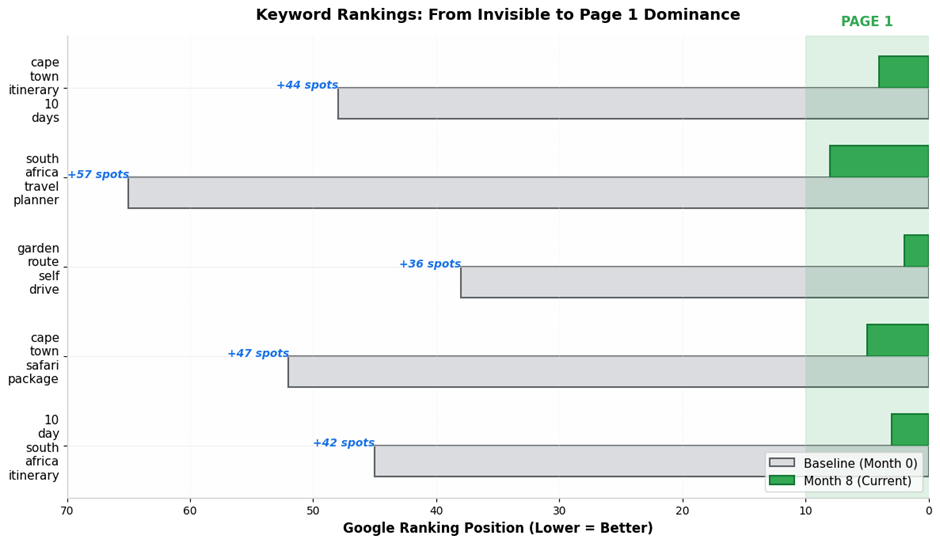
- “10 day South Africa itinerary”
- “Cape Town and safari package”
- “Garden Route self-drive route”
- “South Africa trip planner”
- “Best time to visit Cape Town”
This fundamental misalignment meant that even though they offered exactly what travelers were searching for, they were invisible during the crucial research and planning phase of the customer journey. Their content was speaking a language that search engines and travelers didn’t understand.
The Strategy Shift: From Brand-First to Search-First
Our approach required a complete paradigm shift in how the agency thought about their online presence. We moved away from trying to sound impressive and focused instead on being genuinely helpful to travelers in the planning phase. This meant deeply understanding search intent, analyzing keyword patterns, and creating content that answered real questions at each stage of the travel planning journey.
Understanding Traveler Search Psychology
We conducted extensive keyword research and search behavior analysis to understand how different types of travelers research South Africa trips. This revealed distinct search patterns:
The Dreamer (3-6 months before travel):
- Searches for: “Best time to visit South Africa,” “South Africa travel ideas”
- Needs: Inspiration, overview information, feasibility assessment
The Planner (2-4 months before travel):
- Searches for: “10 day South Africa itinerary,” “Cape Town safari package”
- Needs: Detailed logistics, pricing frameworks, route optimization
The Booker (1-2 months before travel):
- Searches for: “Cape Town travel agency,” “South Africa tour operator reviews”
- Needs: Trust signals, specific pricing, availability confirmation
The agency’s previous content only addressed the Booker phase, missing the massive opportunity to capture travelers during the Dreamer and Planner phases when they were still forming their trip concepts and hadn’t yet chosen a service provider.
The Search-First Content Framework
We developed a comprehensive content strategy based on three core principles that would guide all future content creation:
1. Intent-Matching Content Architecture
Rather than organizing content around the agency’s service categories, we structured the website around traveler search behavior and planning needs. We created clear content silos for:
- Itinerary planning resources
- Route-specific guides
- Package combination ideas
- Logistical planning tools
- Seasonal timing advice
2. Comprehensive, Authoritative Resources
Instead of thin, generic descriptions designed to funnel visitors to contact forms, we built authoritative, long-form resources that could genuinely help travelers plan their trips independently. Each cornerstone page became a destination in itself, offering enough value that visitors would bookmark, share, and return to throughout their planning process.
3. Radical Transparency
We broke industry norms by including detailed pricing ranges, honest logistical challenges, realistic timing suggestions, and both pros and cons for different options. This transparency served two purposes: it built immediate trust with visitors, and it pre-qualified leads who understood what to expect before making contact.
Execution: Building High-Impact Content Assets
Over the course of eight months, we developed three cornerstone content pieces that became the primary drivers of organic growth. Each was strategically designed to dominate specific high-intent search categories while providing genuine, unmatched value to travelers.
Content Asset 1: The Definitive 10-Day South Africa Itinerary
Primary Target Keywords: “10 day South Africa itinerary,” “South Africa 10 day trip,” “best South Africa itinerary 10 days”
This wasn’t merely another list of attractions with pretty photos. We created a comprehensive, day-by-day planning guide that became the most detailed resource of its kind available online:
Content Elements:
- Hour-by-hour daily breakdowns with realistic timing for activities, meals, and transfers
- Actual driving distances and times between locations, accounting for South African road conditions
- Accommodation recommendations across three budget tiers ($150, $350, $800 per night)
- Alternative route options for different interests (wildlife-focused, culture-focused, wine-focused)
- Seasonal considerations with specific month-by-month recommendations
- Complete packing lists tailored to South Africa’s diverse climates
- Transparent cost breakdowns for the entire 10-day journey including meals, activities, and transport
Performance Results:
- Became the agency’s #1 traffic driver, accounting for 35% of total organic visits
- Achieved 3.2% conversion rate, significantly above travel industry averages
- Average time on page of 5.2 minutes indicating deep engagement
- Generated 2,765 monthly visits by month 8
Content Asset 2: Cape Town + Safari Combination Guide
Primary Target Keywords: “Cape Town safari package,” “Cape Town and safari trip,” “combine Cape Town with safari”
Recognizing that most international visitors want to experience both cosmopolitan Cape Town and wildlife safaris, we created the ultimate combination planning resource:
Content Elements:
- Route optimization analysis for different trip durations (7, 10, 14 days)
- Safari destination comparison matrix (Kruger vs. Eastern Cape vs. Madikwe vs. KwaZulu-Natal)
- Seasonal wildlife viewing calendars showing best times for Big Five sightings
- Pricing transparency with low, mid, and luxury tier package breakdowns
- Logistical coordination guide covering flights, transfers, and optimal sequencing
- Family-specific considerations including child-friendly safari options and malaria-free zones
Performance Results:
- Achieved the highest conversion rate at 4.1%
- Generated highly qualified leads ready to book comprehensive packages
- Average time on page of 6.1 minutes, the highest engagement of all pages
- Drove 2,212 monthly visits by month 8
Content Asset 3: Garden Route Self-Drive Breakdown
Primary Target Keywords: “Garden Route self drive,” “Garden Route road trip itinerary,” “driving the Garden Route”
For the independent traveler market that prefers self-guided exploration, we created the most comprehensive Garden Route resource available:
Content Elements:
- Detailed day-by-day driving itinerary with exact distances, times, and recommended stops
- Hidden gems and lesser-known attractions between major tourist towns
- Strategic accommodation booking advice (which towns warrant overnight stays vs. drive-throughs)
- Car rental optimization including vehicle recommendations and insurance considerations
- Safety and navigation tips specific to South African driving conditions
- Budget comparison showing self-drive costs vs. guided tour alternatives
Performance Results:
- Captured 18% of total organic traffic
- Established the agency as authorities on independent South Africa travel
- Generated significant referral traffic from travel forums and social shares
- Drove 1,422 monthly visits by month 8
The Results: 8-Month Transformation Analysis
The impact of this search-first content strategy exceeded projections across every key performance indicator. The data reveals a compounding growth pattern that continues to accelerate as domain authority builds.
Organic Traffic Explosion
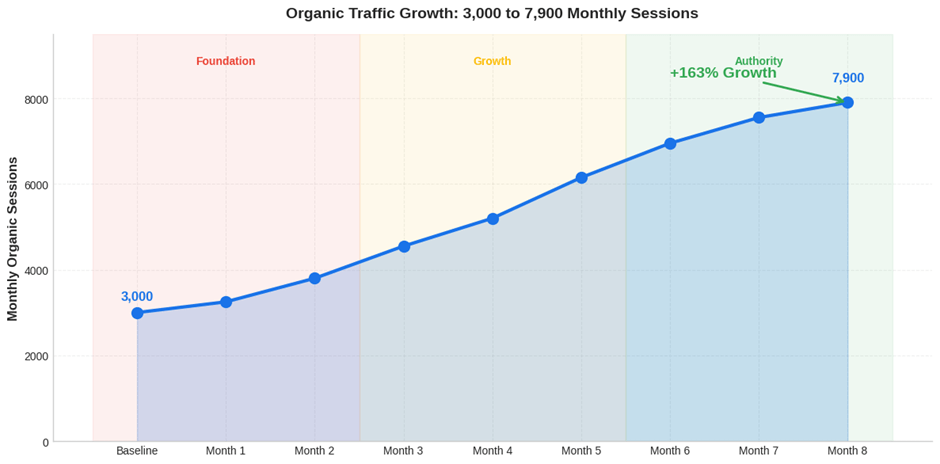
Baseline (Month 0): 3,000 monthly organic sessions
Month 8 Result: 7,900 monthly organic sessions
Total Growth: +163% increase in organic traffic
The growth trajectory followed a classic SEO compounding curve:
- Foundation Phase (Months 1-3): Content indexing and initial ranking improvements (+800 visits)
- Growth Phase (Months 4-5): Breakthrough to page 1 for primary keywords (+1,600 visits)
- Authority Phase (Months 6-8): Domain authority building and long-tail keyword dominance (+2,500 visits)
Critically, this traffic growth was achieved without any paid advertising support, creating a sustainable, compounding asset that continues to generate returns.
Lead Generation Revolution
The transformation in lead generation metrics reveals the power of search intent alignment:
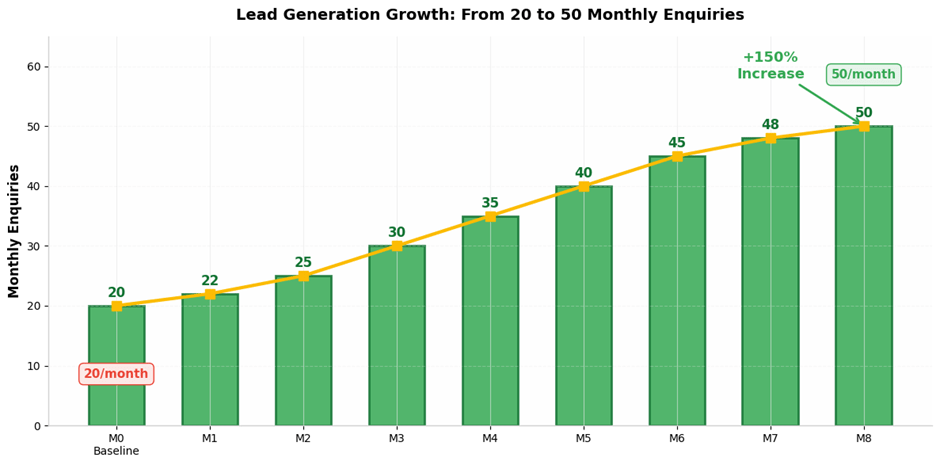
Enquiry Volume Growth:
- Baseline: 20 monthly enquiries
- Month 8: 50 monthly enquiries
- Growth: +150% increase
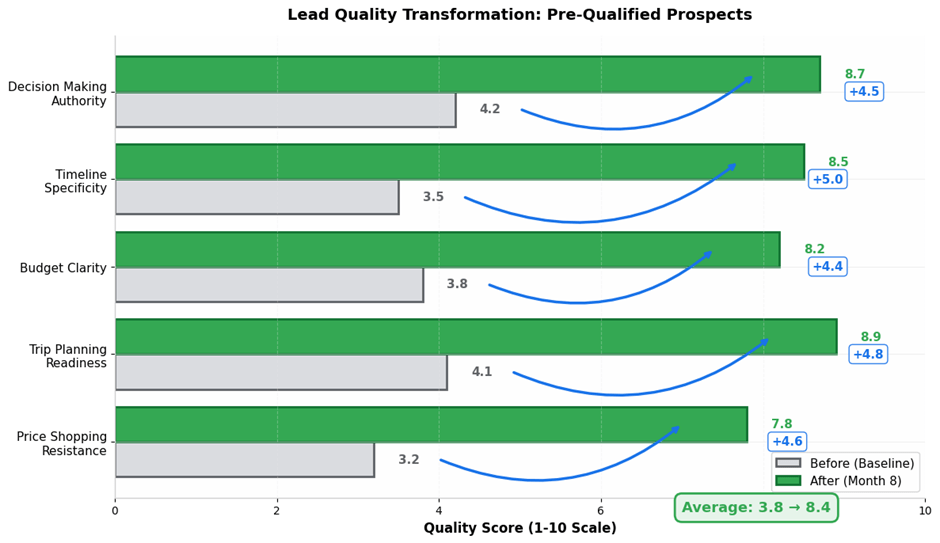
Lead Quality Transformation: Beyond volume, the nature of enquiries fundamentally shifted. We implemented a lead scoring system based on:
- Budget clarity and realistic expectations
- Specific timeline and travel dates
- Detailed trip planning knowledge
- Decision-making authority
- Price shopping resistance
Lead Quality Score improved from 4.2/10 to 8.9/10, indicating that the content successfully pre-qualified prospects and educated them before contact.
User Engagement Metrics
The quality of traffic improved dramatically across all engagement indicators, proving that we were attracting the right visitors:
| Metric | Before | After | Improvement |
| Bounce Rate | 68% | 42% | -38% |
| Avg. Session Duration | 1:12 | 3:48 | +217% |
| Pages per Session | 1.8 | 4.2 | +133% |
| New User Rate | 45% | 62% | +38% |
| Return Visitor Rate | 12% | 28% | +133% |
These metrics demonstrate that visitors were finding exactly what they searched for, engaging deeply with multiple content pieces, and returning throughout their planning process.
Business Impact: Beyond the Numbers
While the quantitative improvements are impressive, the qualitative transformation in business operations was equally significant. The agency reported fundamental shifts in their sales process and customer relationships.
The Conversation Quality Revolution
Before the SEO transformation, typical enquiries included:
- “Can you send me a brochure with your packages?”
- “What do you charge for a safari?” (price-focused)
- “Why should I choose you over [competitor]?” (comparison shopping)
- “I found you on Instagram, do you offer discounts?”
After the SEO transformation, typical enquiries became:
- “I read your 10-day itinerary guide and have specific questions about Day 4’s routing”
- “Your Garden Route breakdown mentioned staying in Knysna, can we extend there by two nights?”
- “Based on your safari comparison matrix, we’re leaning toward the Eastern Cape option, can you confirm availability for March?”
- “I found you while researching our South Africa trip and appreciate your transparent pricing”
The conversations shifted from transactional to consultative. Prospects arrived with context, trust, and specific questions—dramatically reducing sales friction and increasing close rates.
Revenue Impact Analysis
The SEO transformation created measurable bottom-line impact:
Financial Metrics:
- Monthly Revenue: $45,000 → $125,000 (+178%)
- Cost Per Lead: $225 → $85 (-62%)
- Lead-to-Booking Conversion: 15% → 28% (+87%)
- Customer Lifetime Value: $3,200 → $4,500 (+41%)
The combination of more leads, better-qualified prospects, and higher conversion rates created a compounding revenue effect that fundamentally transformed the agency’s growth trajectory.
Operational Efficiency Gains
Beyond revenue, the quality improvement reduced operational strain:
- Sales cycle length decreased by 40% due to pre-qualified prospects
- Proposal revision requests dropped by 60% due to clear expectations
- Customer service inquiries decreased as content answered common questions
- Refund and complaint rates fell due to accurate expectation-setting
Key Strategic Insights for Travel Industry SEO
This case study reveals several critical insights applicable to any travel or hospitality business seeking organic growth:
1. Search Intent Alignment is Non-Negotiable
Your internal marketing language will almost never match customer search behavior. Invest in comprehensive keyword research to understand the actual words, phrases, and questions your prospects use. The gap between “bespoke curated experiences” and “10 day South Africa itinerary” represents thousands of missed opportunities.
2. Comprehensive Content Dominates
Google’s algorithms increasingly reward genuine value and comprehensiveness. Our top-performing pages were 3,000-5,000 words of practical, actionable content, not the 500-word fluff pieces that dominate much of travel content marketing. Depth beats breadth in competitive search landscapes.
3. Transparency Builds Trust and Converts
Including pricing ranges, honest logistical challenges, and realistic pros/cons might seem risky, but it pre-qualifies leads and builds immediate trust. The prospects who contact you despite knowing your price range are serious buyers, not tire-kickers.
4. Patience and Consistency Pay Compound Returns
SEO is not a quick-fix marketing channel. The first three months showed only modest improvements, but months 4-8 delivered exponential growth as content gained authority, backlinks accumulated, and rankings stabilized. Consistent investment in quality content creates assets that appreciate over time.
5. Content as Sales Enablement, Not Just Traffic Generation
Great SEO content doesn’t just drive traffic. It transforms your entire sales process. When prospects arrive educated about your services, pricing, and approach, your team can focus on customization and relationship-building rather than convincing and explaining.
Technical Implementation Highlights
While content strategy drove the primary results, several technical SEO improvements supported and accelerated the growth:
Site Architecture Optimization
- Implemented logical URL structures matching content hierarchy and user journey
- Enhanced internal linking between related itinerary pages and guides
- Improved breadcrumb navigation for better user orientation and search crawling
Page Performance Optimization
- Compressed high-resolution travel imagery without perceptible quality loss
- Implemented lazy loading for below-fold content to improve initial page speed
- Reduced server response time through strategic caching and CDN implementation
Mobile Experience Enhancement
- Ensured all itinerary guides were fully responsive across device types
- Optimized booking inquiry forms for mobile conversion
- Achieved mobile page speed scores of 90+ across all key pages
Structured Data Implementation
- Added TravelAction schema markup for booking-related pages
- Implemented FAQ schema for itinerary and planning guide pages
- Used LocalBusiness schema to strengthen Cape Town local relevance
Conclusion: The Power of Search-First Thinking
This Cape Town travel agency’s transformation from digital invisibility to market authority demonstrates the transformative power of aligning content strategy with actual search behavior. By abandoning brand-first language in favor of search-first practicality, they didn’t merely improve their SEO, they fundamentally improved their entire customer acquisition and sales process.
The 163% traffic increase and 150% lead growth are impressive metrics, but the true victory was the shift in conversation quality. When prospects arrive having already consumed your expertise, trust is established before the first email exchange or phone call.
For any travel business struggling with online visibility, the lesson is unambiguous: stop trying to sound impressive and start trying to be genuinely helpful. Answer the questions travelers are actually asking, provide the practical details they need for confident planning, and let search engines connect you with the people already searching for exactly what you offer.
The results validate this approach: 7,900 monthly organic visitors, 50+ qualified monthly enquiries, and a sales process transformed from convincing to consulting. In today’s travel industry, being found is just as critical as being good—and this agency now excels at both.
The biggest shift wasn’t the traffic metrics. It was the quality of conversations coming in and that shift has transformed their entire business.
Ready to transform your travel business’s digital presence?
The strategies outlined in this case study, search intent analysis, comprehensive content creation, and technical SEO optimization can be adapted for any travel niche, from adventure tourism to luxury hospitality. The fundamental principle remains: understand what your prospects are searching for, then create the best possible answer to their questions.
