
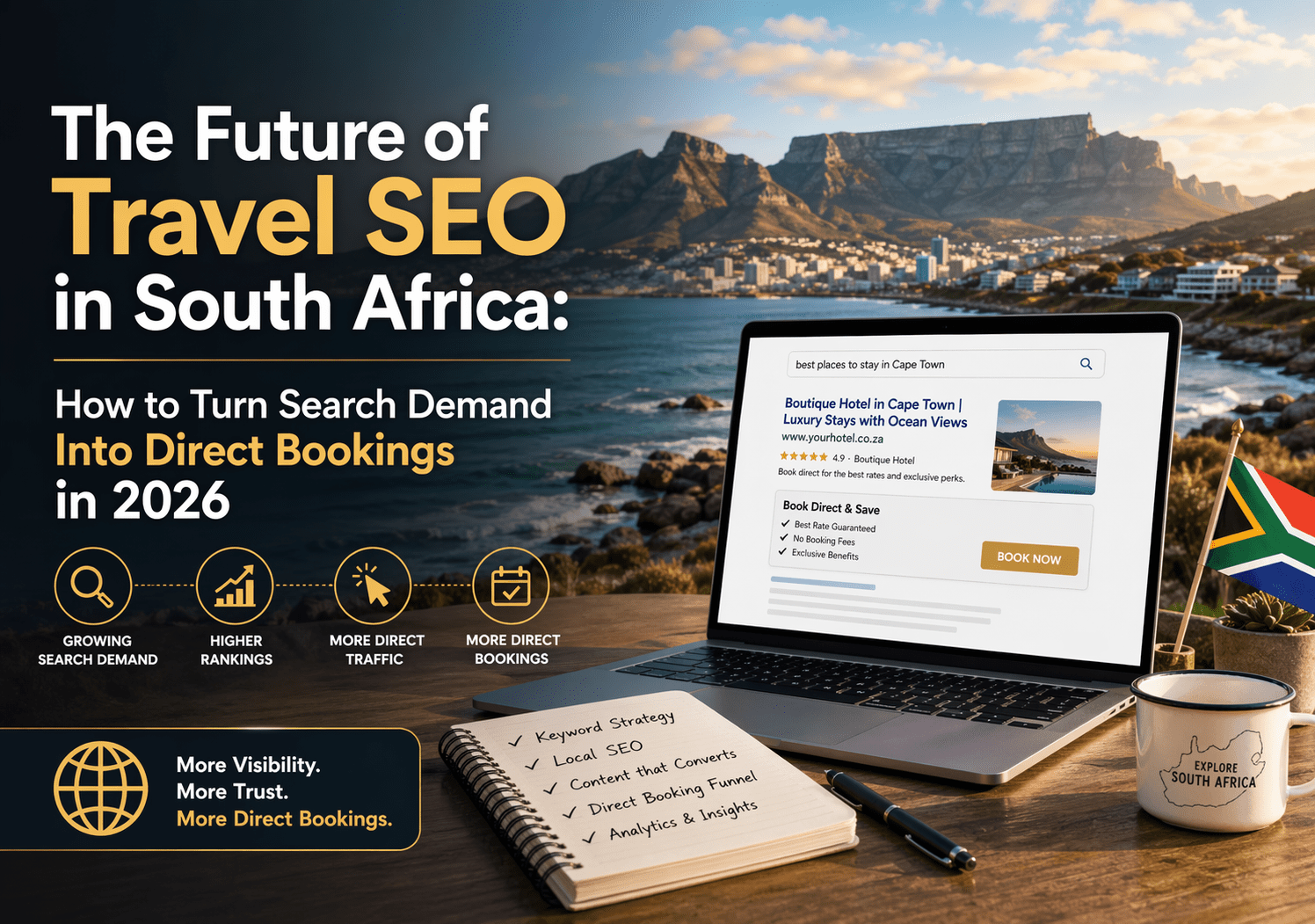
Travel SEO South Africa is reshaping how the travel industry competes and the change is permanent
The travel industry has changed permanently.
Today’s travelers don’t start with booking platforms. They start with Google.
They search. They compare. They explore.
And if your business isn’t visible at that exact moment of intent, you’ve already lost the booking.
That’s why travel SEO in South Africa is no longer optional, it’s your most powerful growth channel.
According to industry insights, travelers rely heavily on search engines to discover destinations, compare experiences, and make booking decisions, making SEO critical in this highly competitive space.
But here’s the shift most travel brands haven’t fully adapted to yet:
SEO isn’t just about traffic anymore.
It’s about capturing demand before OTAs do.
In this guide, we’ll break down exactly how modern travel SEO works—and how your business can dominate search results, attract high-intent travelers, and increase direct bookings.
Why Travel SEO Matters More Than Ever
If you’re a hotel, tour operator, or travel agency, your biggest competitors aren’t just local businesses.
They’re:
- Booking platforms (OTAs)
- Aggregators
- Global travel sites
These platforms dominate search results because they invest heavily in SEO.
But here’s the opportunity:
Travelers still prefer booking directly if they trust what they find.
That’s where a strong LiquidMash SEO strategy comes in.
With the right approach, you can:
- Rank for high-intent travel keywords
- Reduce OTA commissions
- Build long-term organic traffic
- Increase profitability per booking
Understanding the Modern Travel Search Journey
Before you optimise anything, you need to understand how travelers actually search.
The journey typically looks like this:
1. Inspiration Stage
“Best safari experiences in South Africa”
2. Consideration Stage
“Kruger National Park safari tours prices”
3. Decision Stage
“Book luxury safari lodge South Africa”
Each stage requires different content and SEO strategies.
Most travel businesses focus only on the final stage and miss out on massive traffic earlier in the journey.
The 5 Pillars of High-Performance Travel SEO
1. High-Intent Keyword Targeting
Not all traffic is valuable.
You don’t want just visitors—you want bookings.
That’s why your SEO strategy should focus on:
- Destination keywords (e.g. “Cape Town tours”)
- Experience keywords (e.g. “wine tasting Stellenbosch”)
- Booking keywords (e.g. “book safari South Africa”)
At LiquidMash we focus on aligning keywords with traveler intent, ensuring every click has revenue potential.
2. Local SEO for Travel Businesses
If you operate in South Africa, local SEO is your competitive edge.
Searches like:
- “things to do in Johannesburg”
- “best hotels in Cape Town”
- “safari tours near me”
Are high-converting.
Local SEO includes:
- Google Business Profile optimisation
- Location-based landing pages
- Local backlinks and citations
This is especially critical in major markets like:
- Johannesburg
- Cape Town
- Western Cape
3. Content That Drives Bookings (Not Just Traffic)
Travel content is powerful, but only if it converts.
Instead of generic blogs, focus on:
- Destination guides
- Itineraries
- Comparison articles
- “Best of” lists
Tourism blogs are most effective when they help users visualise their experience, turning inspiration into real trips.
For example:
- “3-Day Cape Town Itinerary”
- “Best Safari Lodges in South Africa for Couples”
Each piece should guide users closer to booking.
4. Technical SEO & Site Performance
Even the best content won’t rank if your site is slow or broken.
Key areas:
- Page speed optimisation
- Mobile responsiveness
- Structured data
- Clean site architecture
Google prioritises user experience, especially on mobile.
If your site loads slowly, travelers will leave and book elsewhere.
5. AI-Driven SEO (The Competitive Advantage)
SEO is evolving fast.
AI is now shaping:
- Search results
- Content visibility
- User intent analysis
An advanced LiquidMash strategy allows you to:
- Predict what travelers will search next
- Optimise content faster
- Adapt to algorithm changes
This is where most competitors fall behind.
How to Reduce OTA Dependency with SEO
Online Travel Agencies (OTAs) are powerful, but expensive.
They charge high commissions and control customer relationships.
SEO helps you:
- Attract direct traffic
- Own your customer data
- Increase margins
Instead of relying on platforms, you build your own direct booking engine.
Local SEO Strategy for South African Travel Brands
If you want to dominate your region, here’s what you need:
Location Pages
Create pages for:
- Johannesburg tours
- Cape Town experiences
- Kruger safaris
Google Business Optimisation
Ensure:
- Accurate details
- Regular updates
- Reviews and photos
Local Content
Write about:
- Local attractions
- Events
- Travel tips
This signals relevance to search engines and boosts visibility.
Content Strategy That Converts Travelers
Here’s a simple framework:
Top of Funnel (Traffic)
- Travel inspiration blogs
- Destination guides
Middle of Funnel (Consideration)
- Comparison content
- Reviews
- Itineraries
Bottom of Funnel (Bookings)
- Landing pages
- Booking pages
- Service pages
Each stage moves users closer to booking.
Link Building for Travel SEO
Backlinks are still a major ranking factor.
Effective strategies:
- Guest blogging on travel sites
- Partnering with tourism boards
- Creating shareable content
The goal: build authority and trust.
Measuring Travel SEO Success
Track:
- Organic traffic
- Keyword rankings
- Conversion rates
- Direct bookings
SEO isn’t just about visibility. It’s about revenue.
Common Travel SEO Mistakes to Avoid
- Targeting only generic keywords
- Ignoring local SEO
- Publishing low-quality content
- Slow website performance
- No clear conversion strategy
Fix these and you’ll outperform most competitors.
The Role of AI in Travel Search
Search is becoming more predictive.
AI-driven systems now:
- Understand user intent better
- Personalise results
- Prioritise high-quality content
That means your SEO strategy must evolve.
Why Most Travel Websites Fail to Rank
The biggest issue?
They treat SEO as an afterthought.
Successful travel brands:
- Invest in strategy
- Focus on intent
- Optimise continuously
FAQs
What is travel SEO?
Travel SEO is the process of optimising a travel website to rank higher on search engines, attract travelers, and increase bookings.
How long does travel SEO take to work?
Most businesses see results within 3–6 months, with stronger growth over time.
Why is local SEO important for travel businesses?
Local SEO helps you appear in location-based searches, attracting nearby and destination-specific travelers.
How can SEO increase direct bookings?
By ranking for high-intent keywords, SEO brings users directly to your site, reducing reliance on OTAs.
What is AI SEO in travel marketing?
AI SEO uses artificial intelligence to analyse search trends, optimise content, and improve rankings faster.
Conclusion: Turn Search Visibility Into Bookings
Travel SEO is no longer just about rankings, it’s about owning your demand.
If your business isn’t visible when travelers are searching, you’re handing bookings to competitors.
The good news?
With the right strategy, you can:
- Rank above OTAs
- Attract high-intent travelers
- Increase direct bookings
- Build a sustainable growth channel
Ready to Dominate Travel Search in South Africa?
Stop losing bookings to OTAs and start building a predictable, high-converting traffic engine.
👉 Get a custom strategy from LiquidMash
👉 Or request your free audit here: https://www.liquidmash.io/travel-tourism-seo-agency/
Your future bookings are already being searched for.
Make sure they find you first.
