
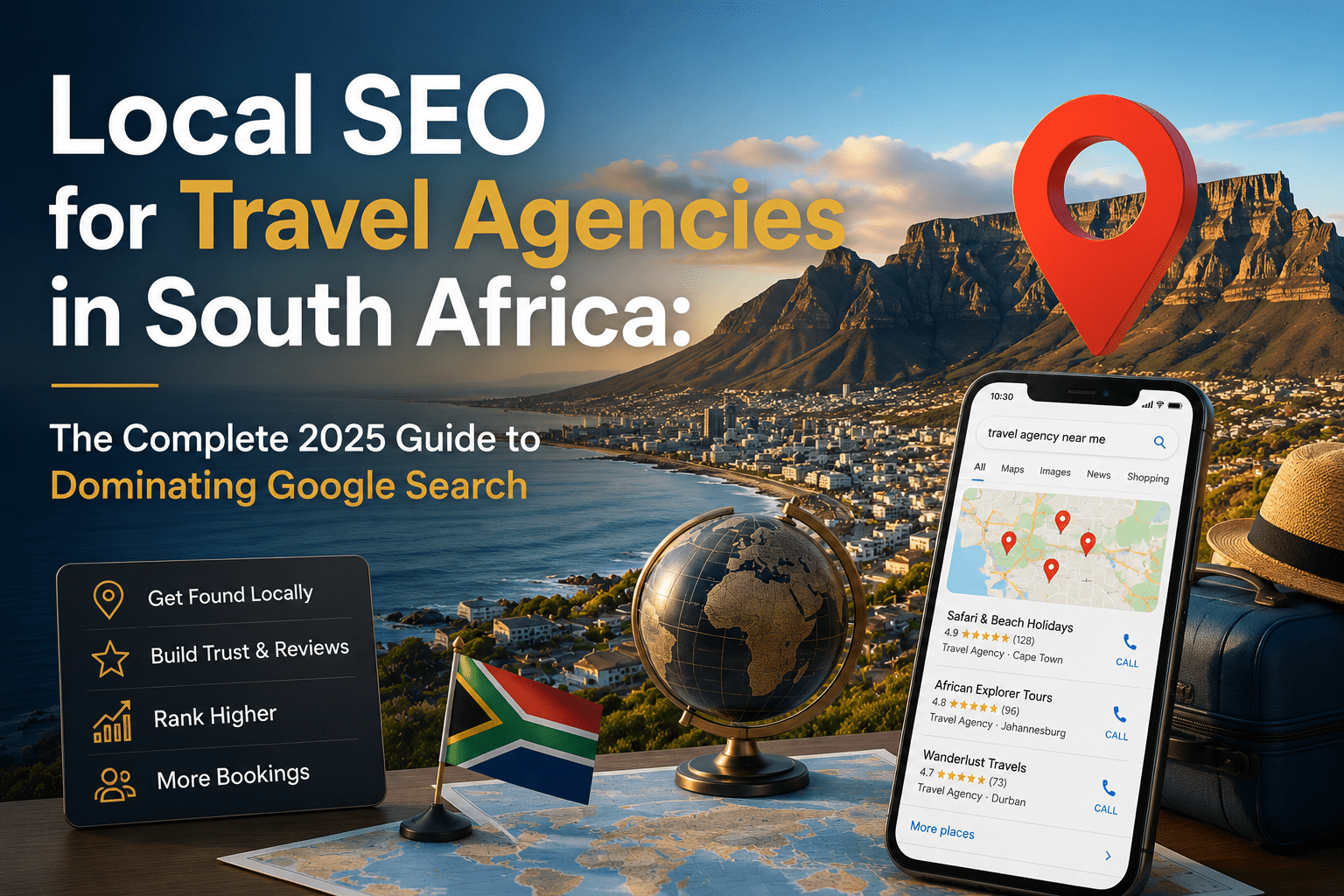
Published by LiquidMash | Travel & Tourism SEO Specialists | South Africa
If you run a travel agency, tour operator, or safari company in South Africa and you’re not showing up on the first page of Google, you’re losing bookings to competitors right now. This guide breaks down exactly how local SEO for travel agencies works, why it matters more than ever in 2025, and what you can do today to start ranking for the searches that drive real bookings.
What Is Local SEO and Why Does It Matter for South African Travel Businesses?
Local SEO (Search Engine Optimisation) is the process of optimising your online presence so that your business appears in Google’s results when people search for travel services in a specific location. For example, when a traveller types “Cape Town day tours” or “safari packages Johannesburg” into Google, local SEO is what determines whether your business appears or whether your competitor does.
For travel businesses in South Africa, local SEO is not optional. It is the difference between a booked-out calendar and an empty one.
South Africa’s tourism industry is fiercely competitive. Online Travel Agencies (OTAs) like Booking.com, Viator, and GetYourGuide have massive SEO budgets. If your website is not actively optimised for local search, you are handing those customers and their booking commissions directly to platforms that charge you 15–30% per transaction.
The good news? With the right travel and tourism SEO strategy, independent travel businesses can compete with and beat OTAs for high-intent local search terms. We have done it for clients across Cape Town, Johannesburg, the Garden Route, and Kruger, and this guide will show you how.
The 5 Pillars of Local SEO for Travel Agencies in South Africa
1. Google Business Profile Optimisation
Your Google Business Profile (GBP) is the single most important local SEO asset you have. It is what drives your appearance in Google Maps results, the local pack (the 3 listings that appear at the top of search results), and Google’s AI-generated answers to travel-related queries.
For South African travel businesses, a fully optimised GBP includes:
- A complete and accurate business name, address, and phone number (NAP)
- Your primary business category set to the most specific option available (e.g.,
“Tour Operator” or “Travel Agency”)
- A keyword-rich business description that mentions your key destinations and services
- High-quality photos of your tours, vehicles, guides, and experiences (minimum 20 photos)
- Regular Google Posts featuring offers, seasonal packages, and destination content
- A consistent review generation strategy targeting 4.8+ star ratings
- Q&A populated with the most common questions your customers ask
Businesses that fully optimise their GBP see an average 3x increase in calls and direction requests from local search. For our Garden Route adventure client, this alone helped them enter the Local Pack Top 3 for core activity keywords within four months.
2. Location-Specific Landing Pages
One of the biggest SEO mistakes travel businesses make is lumping all their tours or packages onto a single page. Google cannot rank a page for “ziplining Garden Route” if that page also covers kayaking, hiking, and mountain biking across three provinces.
The solution is dedicated location-specific landing pages. One page per experience, per destination. Each page should:
- Target a specific high-intent keyword (e.g., “guided hiking tours Cape Town”)
- Include at least 800–1,200 words of original, helpful content
- Feature real customer reviews and photos from that specific experience
- Have a clear booking call-to-action above the fold
- Include structured data markup (schema) for tours, activities, and reviews
This is the foundational architecture of any effective local SEO strategy for tour operators. Without it, you are asking Google to rank a single page for dozens of keywords it was never designed to target.
3. Local Keyword Research With Traveller Intent
Not all keywords are created equal. For travel businesses in South Africa, the most valuable keywords are those that signal booking intent, searches made by travellers who have already decided on a destination and are now looking for an experience to book.
Examples of high-intent local travel keywords:
- “adventure activities Garden Route” — traveller is planning and ready to book
- “best safari packages from Johannesburg” — high commercial intent, comparing options
- “Cape Town township tours” — specific experience, destination confirmed
- “family tours Kruger National Park” — qualified audience, ready to convert
In contrast, keywords like “South Africa travel tips” or “what to pack for a safari” attract information-seekers who may not book for months, or at all. Both types of content have their place, but your core service pages should target the bottom-of-funnel, high-intent keywords that drive direct bookings.
At LiquidMash, our AI-integrated SEO approach uses predictive keyword analysis to identify exactly which searches your target audience is making at each stage of the booking journey, so we build content that captures demand at every touchpoint.
4. Local Citation Building and NAP Consistency
A local citation is any online mention of your business name, address, and phone number. Google uses citations to verify that your business is legitimate and to confirm your location. Inconsistent citations, different phone numbers, misspelled business names, or outdated addresses across directories actively hurt your local rankings.
For South African travel businesses, priority citation sources include:
- Google Business Profile
- TripAdvisor
- Yelp South Africa
- SafariBookings.com
- SA Tourism (SouthAfrica.net)
- HelloPeter
- Foursquare
- Apple Maps
We recommend auditing your citations every 6 months and correcting any inconsistencies immediately. Citation cleanup alone can produce meaningful local ranking improvements within 60 days.
5. Locally Relevant Content Marketing
Google’s 2024 Helpful Content Update was unambiguous: thin, generic travel content will not rank. What ranks in 2025 is genuinely useful, locally specific content written for real travellers, not keyword-stuffed articles designed to game an algorithm.
For South African travel businesses, this means publishing content that answers the specific questions your customers are asking:
- “What is the best time of year to visit the Drakensberg?”
- “How far is Kruger National Park from Johannesburg?”
- “Is the Garden Route suitable for families with young children?”
- “What permits do I need for hiking in the Cederberg?”
This type of content builds your topical authority as a travel expert, earns backlinks from other tourism and media sites, and feeds Google’s AI systems with the high-quality information they need to surface your business in AI-generated search results (SGE/AIO).
Local SEO vs. Traditional SEO: What’s Different for Travel?
Standard SEO focuses on ranking a website nationally or globally for broad keywords. Local SEO focuses specifically on ranking within a geographic area, making it the primary growth lever for most South African travel businesses whose customers are searching for destination-specific experiences.
The key differences:
- Local SEO prioritises Google Maps and the local pack, not just organic blue links
- Reviews and ratings are a local ranking factor. They have no direct impact in traditional SEO
- Proximity plays a role: Google considers the searcher’s location relative to your business
- Local citations and directory listings matter significantly more in local SEO
For travel businesses serving both local South African travellers and international visitors, a blended approach is most effective: strong local SEO foundations combined with international keyword targeting and hreflang implementation for global audiences.
How AI Is Changing Local SEO for South African Travel Businesses
Google’s AI-powered search results (SGE/AIO) are reshaping how travel businesses get discovered. Instead of simply listing ten blue links, Google now generates AI summaries that directly answer travel queries, often without the searcher clicking through to a website at all.
To appear in these AI-generated answers (a practice known as Answer Engine Optimisation, or AEO), your content needs to:
- Directly and concisely answer specific travel questions
- Be structured with clear headings, bullet points, and FAQ sections
- Demonstrate expertise, authority, and trustworthiness (E-E-A-T)
- Use structured data markup (schema) to help Google understand your content’s context
- Earn mentions and links from authoritative travel and tourism publications
Businesses that optimise for AEO and Generative Engine Optimisation (GEO) today are positioning themselves to dominate search visibility in 2025 and beyond. While competitors who ignore these shifts will see their organic traffic decline as AI summaries absorb more click share.
This is precisely why we built AI-integrated SEO into the core of our travel SEO services. Our clients are not just ranking in traditional search, they are being cited in AI-generated answers for high-value travel queries.
Common Local SEO Mistakes South African Travel Businesses Make
In auditing hundreds of travel websites across South Africa, we see the same mistakes repeatedly:
- Using a single-page website with all tours or packages listed together (no individual landing pages)
- Neglecting Google Business Profile — incomplete information, no photos, no reviews strategy
- Targeting only broad, high-competition keywords and ignoring long-tail, high-intent searches
- Publishing thin content that describes services without addressing customer questions
- Ignoring mobile optimisation — over 70% of South African travel searches happen on mobile
- Slow website load times (above 3 seconds on mobile) — a major ranking penalty
- No internal linking structure between service pages, blog content, and destination guides
- Failing to build local backlinks from South African tourism boards, media, and directories
Each of these mistakes is fixable. And each fix produces measurable ranking improvements, usually within 60–90 days of implementation.
What Results Can South African Travel Businesses Expect From Local SEO?
Based on our work with travel businesses across South Africa, here is what a well-executed local SEO strategy typically delivers:
- Month 1–2: Technical improvements, GBP optimisation, citation cleanup — foundation building
- Month 3–4: Initial keyword movements, increased GBP calls and direction requests
- Month 4–6: First-page rankings for long-tail, high-intent local keywords
- Month 6–12: Sustained traffic growth, top-3 local pack positions for primary keywords, measurable increase in direct bookings
These are not inflated projections. These are the actual timelines we see with clients who commit to a consistent, properly executed strategy. SEO is not a quick fix — it is a compounding growth engine that builds momentum over time.
Read our Tour Operator SEO case study to see exactly how a Garden Route adventure business doubled its traffic and entered the Local Pack Top 3 in just four months.
Getting Started: Your Local SEO Action Plan
If you are a travel agency, tour operator, safari lodge, or travel experience provider in South Africa, here is where to start:
- Audit your Google Business Profile and correct every incomplete field
- Check your NAP consistency across all major directories and citation sources
- Map your services to specific keywords and create dedicated landing pages for each
- Implement a review generation process to build your ratings consistently
- Publish at least two pieces of destination-specific content per month
- Ensure your website loads in under 3 seconds on mobile devices
- Add schema markup to your tour, activity, and review pages
If this feels overwhelming, you do not have to do it alone. A specialist travel SEO agency can audit your current position, identify your fastest-growth opportunities, and implement a strategy that compounds over time.
Ready to dominate local search in South Africa? Get your Free Travel SEO Audit (worth R5,000) at www.liquidmash.io/travel-tourism-seo-agency — Limited spots available. Book a free strategy call today: +27 21 012 25091
About LiquidMash: We are South Africa’s specialist travel and tourism SEO agency. We help tour operators, safari lodges, travel agencies, and experience providers rank higher on Google, attract more high-intent travellers, and increase direct bookings. Serving Johannesburg, Cape Town, the Western Cape, and all of South Africa.
