
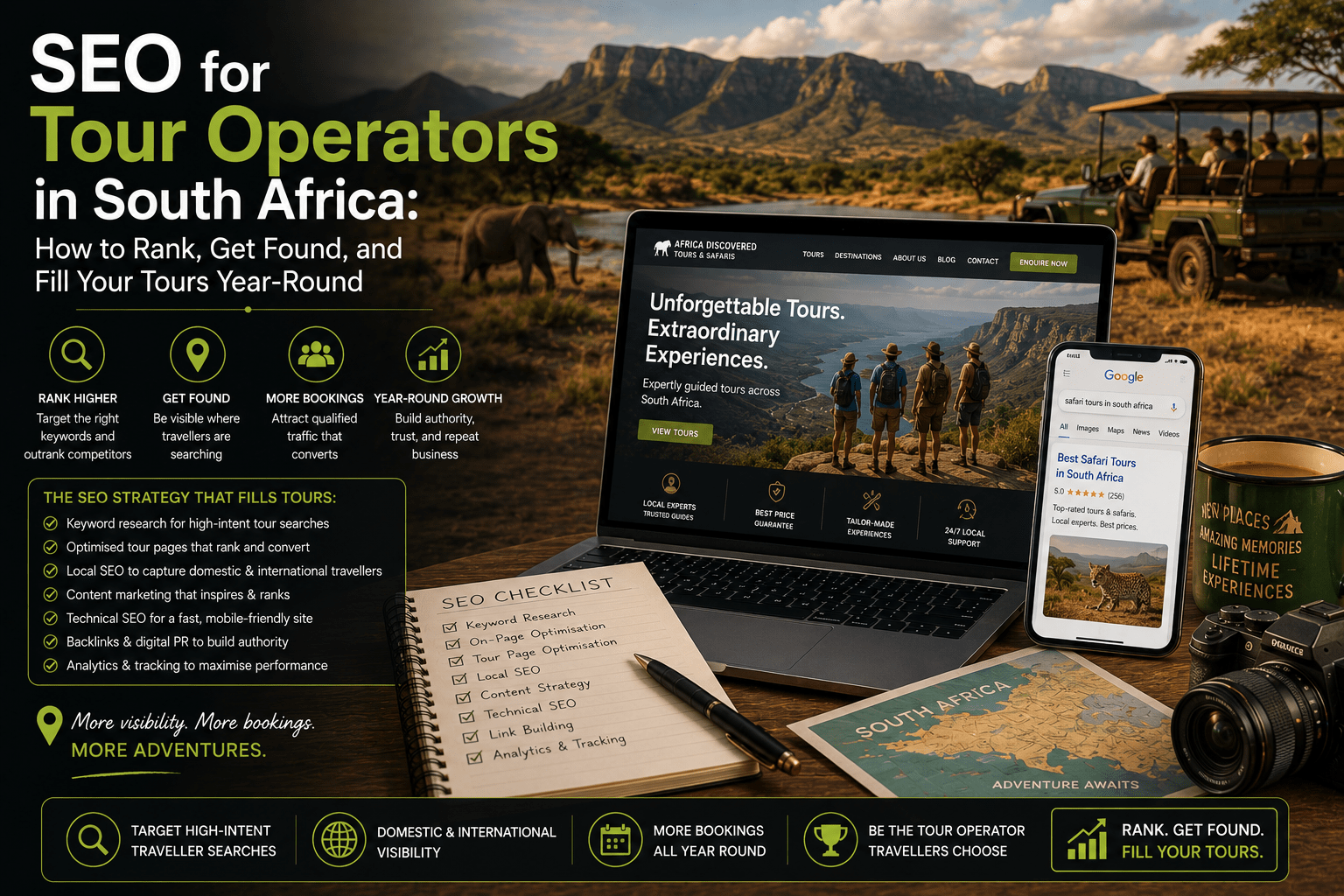
Every week, hundreds of thousands of travellers type queries like ‘best safari tours South Africa’, ‘Garden Route self-drive itinerary’, and ‘private whale watching tour Hermanus’ into Google. The vast majority of those searches result in a click on page one — and most of those page-one results belong to Expedia, GetYourGuide, Viator, or a handful of well-funded outbound tourism platforms.
If you are a South African tour operator and your website is not on page one for the searches your ideal clients are making, you are invisible at the exact moment of peak buying intent.
This is the core challenge of SEO for tour operators in South Africa — and it is also the core opportunity. Unlike the hotel sector, the tours and activities space is still relatively underserved by sophisticated SEO. Most operators are either relying entirely on listing platforms, or doing basic SEO with no clear keyword strategy. The gap between ‘basic presence’ and ‘page-one authority’ is smaller than operators think — and the commercial impact of closing that gap is transformative.
Why Tour Operators in South Africa Struggle with Search Visibility
The primary reason South African tour operators underperform in organic search is structural: most operator websites are brochure sites, not content ecosystems. They list tours, include a booking form, and stop there. This approach tells Google very little about your expertise, your destination knowledge, or your authority in the travel space.
Google’s ranking algorithm rewards what it calls Topical Authority — the breadth and depth of content you have published on a given subject. A tour operator with 50 well-researched pages covering Kruger National Park safari experiences will consistently outrank one with a single ‘Kruger Safari Tours’ page, even if the latter has better photography and a cleaner booking flow.
Building this authority is the central goal of a properly structured travel and tourism SEO strategy for South African operators.
The Search Intent Map: Understanding How Travellers Actually Find Tours
Tour operator SEO is not just about ranking for ‘tours in South Africa’. The traveller buying journey moves through distinct search intent stages, each requiring different content:
Stage 1 — Inspiration (Informational Intent)
The traveller is dreaming and researching. They search: ‘what to do in South Africa for 2 weeks’, ‘is a Kruger self-drive safe’, ‘best time to see the Big Five’. At this stage, content that answers these questions — blog posts, guides, itineraries — builds your brand presence and earns backlinks from travel publications.
Stage 2 — Planning (Navigational / Comparison Intent)
The traveller is narrowing their choices. Searches become: ‘best guided safari tours Kruger vs Pilanesberg’, ‘Garden Route tour operators reviewed’, ‘Cape Town township tour ethical operators’. Comparison content, destination guides, and FAQ pages capture this traffic and position your brand as a trusted advisor.
Stage 3 — Booking (Transactional Intent)
The traveller is ready to book. They search: ‘book Kruger safari 5 days’, ‘Garden Route guided tour price’, ‘private whale watching tour Hermanus’. This is where your tour product pages need to rank — with booking functionality, clear pricing, and strong social proof.
Most tour operators only optimise for Stage 3. A comprehensive SEO strategy captures travellers at all three stages, building trust early and maintaining visibility through to conversion.
Safari Tour SEO: The Highest-Value Keyword Cluster in South African Tourism
Safari-related searches represent the single highest-value keyword cluster for South African inbound tourism. International travellers searching for ‘Africa safari tours’ are typically high-intent, high-budget bookers with longer lead times — meaning they begin their search months before travel.
For tour operators competing in this space, the keyword strategy must distinguish between:
- High-competition broad terms (‘safari tours South Africa’) — difficult to rank for organically without significant domain authority
- Medium-competition destination terms (‘Kruger National Park safari operator’, ‘Sabi Sand game reserve tours’) — achievable with strong on-page content and local citations
- Low-competition long-tail terms (‘private 3-day walking safari Limpopo’, ‘malaria-free safari lodge day trip Pilanesberg’) — highly achievable within 3–4 months
A well-structured safari tour SEO campaign targets all three tiers simultaneously, using long-tail content to build initial authority and traffic while progressively improving rankings for more competitive terms over 6–12 months.
Garden Route Tourism Marketing: A Case Study in Destination Content SEO
The Garden Route is South Africa’s most searched domestic tourism destination and one of the most researched international routes in sub-Saharan Africa. For tour operators based in or offering packages along the Garden Route — from Mossel Bay to Storms River — destination content is the single most powerful SEO lever available.
Destination content means building genuine, useful, search-optimised resources about the Garden Route as a destination, not just as a product backdrop. This includes:
- ‘The Complete Garden Route Itinerary: 10 Days from Cape Town to Port Elizabeth’ — targets ‘Garden Route itinerary’ and related queries
- ‘Tsitsikamma National Park: What to Know Before You Visit’ — captures travellers in the planning phase
- ‘Bungee Jumping Bloukrans Bridge: Everything First-Timers Need to Know’ — targets a specific high-interest activity query
- ‘Garden Route for Families: Best Activities for Kids’ — captures a high-intent sub-segment of domestic travellers
Each piece of destination content serves a dual purpose: it attracts organic search traffic and it demonstrates your expertise to both travellers and Google. Our case study on how a Garden Route adventure business achieved predictable revenue through tour operator SEO demonstrates exactly how this content architecture produces results in a real operator context.
International SEO for South African Inbound Tourism Operators
For operators targeting inbound tourists — from the UK, Germany, USA, Netherlands, and Australia, South Africa’s primary source markets — domestic SEO is insufficient. International search visibility requires a specific set of technical and content considerations:
Hreflang and Geo-Targeting
If your operator serves primarily international markets, your website needs geo-targeting signals so Google serves it to international audiences. This includes correct hreflang tags for English variants (en-gb, en-us, en-au), and Google Search Console geo-targeting set to South Africa.
International Keyword Research
Search behaviour differs by country. British travellers search ‘South Africa holiday packages’ while American travellers search ‘South Africa vacation tours’. South African operators often optimise for local English without accounting for these variant search patterns across their source markets.
Trust Signals for International Audiences
International travellers booking tours in a foreign country weight trust signals heavily. This means Schema markup displaying your review rating, membership in South African Tourism (SAT) accreditation logos, and prominently featured payment security indicators all have measurable effects on international conversion rates.
Our case study on 163% organic growth for a Cape Town tourism business demonstrates how combining local and international SEO strategy produced compounding results across both domestic and inbound traveller segments.
The Seasonal SEO Problem — and How to Solve It
Tour operator revenue in South Africa is highly seasonal. Whale season in Hermanus runs June–November. Big Five sightings peak in the dry winter months in Kruger (May–August). The Cape Town summer (December–February) drives dramatically higher search volumes than the rest of the year.
Most operators allow their organic visibility to fluctuate with seasonality — they rank well during peak season and disappear in off-peak months. A strategic approach to destination marketing SEO reverses this pattern:
- Publish off-season content 3–4 months before the off-season begins, so it has time to rank before demand drops
- Target year-round experience queries that are not season-dependent (‘Cape Town wine tours’, ‘Cradle of Humankind day tour from Johannesburg’)
- Use seasonal content to build domain authority year-round, so peak-season pages rank faster when they matter most
The transformation from feast-and-famine revenue cycles to predictable year-round bookings through strategic content SEO is the central theme of our tour operator SEO case study on seasonal revenue stabilisation.
Technical SEO Considerations for Tour Operator Websites
Beyond content, the technical health of your website determines whether Google can effectively index and rank your tour pages. The most common technical SEO failures on South African tour operator websites are:
- Slow page load speeds on mobile (most travel searches happen on mobile, and Google’s ranking algorithm directly weights page speed)
- Duplicate tour listing pages created by booking engine filters, producing thin or identical content across multiple URLs
- Missing Schema markup for TouristAttraction, TouristTrip, or Event types — leaving Google without the structured signals it needs to display rich results
- No HTTPS encryption, or mixed content errors undermining security signals
- Broken internal links between blog posts and tour product pages, preventing Google from distributing page authority across the site
Resolving these technical issues is typically the fastest way to see initial ranking improvements — often within 4–8 weeks of implementation.
Building Backlinks as a South African Tour Operator
Domain authority — which is built primarily through backlinks from other reputable websites — remains one of Google’s most significant ranking factors. For South African tour operators, the most effective backlink sources are:
- South African Tourism Board and provincial tourism body listings (official government and parastatal tourism portals carry high authority)
- National park and conservation body websites (SANParks, Ezemvelo KZN Wildlife, CapeNature)
- Travel media features in publications like Getaway Magazine, Africa Geographic, Lonely Planet, and Condé Nast Traveller
- Hotel and accommodation cross-referral links (if you partner with specific lodges or hotels for packaged offerings)
- Conservation and NGO partnership pages (relevant for operators offering wildlife conservation experiences or responsible tourism products)
Frequently Asked Questions
How competitive is SEO for tour operators in South Africa?
It is competitive at the broad keyword level (e.g., ‘South Africa tours’) but significantly less competitive for destination-specific and experience-specific long-tail queries. Most operators have not invested in content-driven SEO, creating clear ranking opportunities for those who do.
Should South African tour operators do SEO or focus on OTA listings?
Both, but with a clear strategic priority. OTA listings provide immediate visibility but at 20–30% commission per booking. SEO builds an owned, commission-free channel over 6–12 months. The optimal approach — moving from OTA-dependence to direct-driven bookings — is documented in our direct booking case study.
How many blogs does a South African tour operator need to rank on Google?
There is no fixed number, but operators who consistently publish 2–4 destination or experience-focused blog posts per month typically see significant ranking improvements within 6 months. Quality and keyword targeting matter more than volume.
Can a small tour operator compete with Viator and GetYourGuide in Google Search?
Not for broad, high-volume keywords — but for long-tail, destination-specific searches, yes. A tour operator with deep local expertise, well-structured content, and active Google Business Profile management can absolutely outrank aggregator platforms for specific, high-intent queries.
Want a custom SEO roadmap for your South African tour operation? Request your free travel SEO audit — tailored to your destination, your tours, and your source markets.
